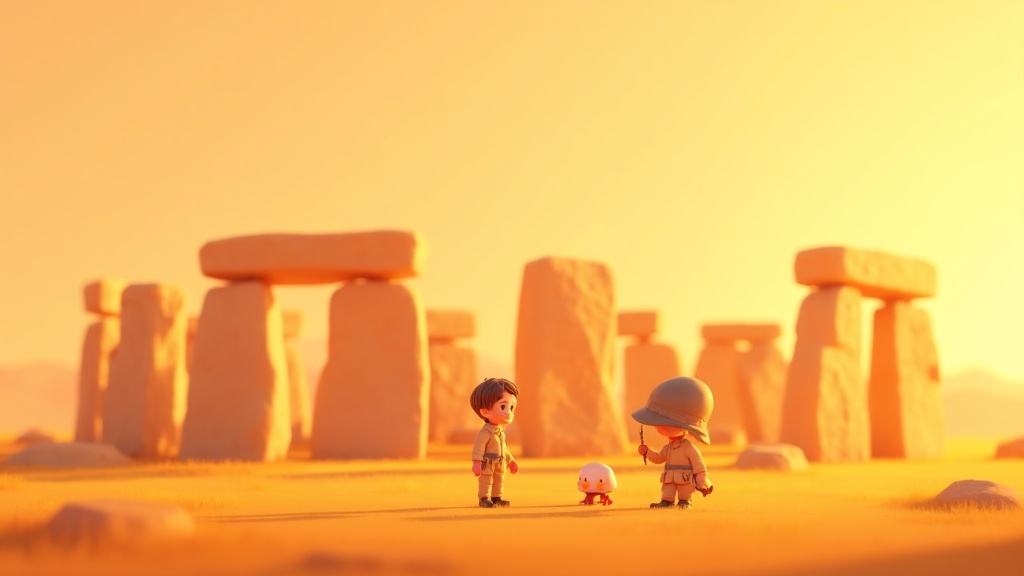

Stonehenge is a massive, circular prehistoric monument in England built over 1,500 years, starting around 3000 BC. It features huge sarsen stones weighing 25 tons each, brought from miles away. Discover the amazing engineering skills of these Stone Age builders!
Imagine this: Huge, towering stones, standing mysteriously in a field for thousands of years. What is this amazing place, and who had the super-strength (or smarts!) to build it?
That incredible place is Stonehenge, located on Salisbury Plain in England! It’s one of the world’s most famous prehistoric monuments, made up of huge stone blocks called megaliths. Building Stonehenge wasn't a quick weekend project—it happened over a HUGE amount of time, starting around 3000 BC and continuing in stages until about 1500 BC! That’s longer than the time between now and the Roman Empire! We know it was built by people from the Neolithic Period (the New Stone Age) and the Bronze Age, but figuring out *exactly* who they were is part of the awesome puzzle for kids today!

Mira says:
"Wow! Moving stones that weigh as much as 25 elephants without wheels or metal tools sounds impossible! These ancient builders were definitely history's first master engineers!"
What is Stonehenge, Really?
Stonehenge isn't just a random pile of rocks; it’s a giant, circular monument! It has a few main parts. First, there’s the outer ring made of massive stones called sarsens, which are topped by horizontal stones called lintels.
Inside that, you find a circle of smaller stones called bluestones. Then, there’s a horseshoe shape made of even bigger sarsen stones called trilithons (that means three stones: two uprights and one lintel on top!).
The whole thing is surrounded by an earthwork—a circular ditch and bank—which came first! Even though it looks like ruins now, it was once an even grander structure, perhaps reaching over 13 feet (4.0 m) high for the standing stones.
Mind-Blowing Fact!
The name 'Stonehenge' might come from the Old English words 'stan-hengen,' which means 'stone hanging' or 'gallows'—maybe because the horizontal stones were perched on top!
Just How Big Were These Stones?
When we say 'huge,' we mean HUGE! The builders used two main types of rock for the main circle.
The biggest stones, the sarsens, were brought from a place called West Woods in Wiltshire, about 20 miles (32 km) away. These heavyweights weigh about 25 tons on average! That’s as heavy as about five large family cars stacked on top of each other!
Even more amazing are the bluestones. These smaller rocks were brought from the Preseli Hills in Wales, which is an incredible 150 miles (240 km) away! Some of these bluestones weighed about 2 tons each.
(From 3000 BC to 1500 BC)
(Like 5 big cars!)
(From Wales)
(In the earliest earthwork)
How Did They Move and Raise Those Giant Stones?
This is the biggest puzzle! The people who built Stonehenge lived *before* the invention of the wheel or metal tools. So how did they manage this epic construction feat?
For the sarsens, it’s believed they used sledges pulled by hundreds of people over logs or tracks. Some modern ideas suggest they might have even used animal fat to grease the sledges to help them slide!
For raising the upright stones, they dug a deep hole with a sloping side and used plant fiber ropes and maybe a big wooden A-frame (called a sheerleg) to haul the stone up. They would pack the hole securely with rubble once the stone was standing.
Putting the Top Stones On
Getting the heavy horizontal lintel stones on top was tricky! Archaeologists think they might have used timber platforms to raise them up, or perhaps they rocked the stone slowly onto small piles of rubble, slowly building a ramp underneath it until it was upright.
💡 Did You Know?
DNA evidence suggests that some of the people who were buried near Stonehenge may have originally come from far away, possibly even near where the bluestones were quarried in Wales! It was a huge community effort!
🎯 Quick Quiz!
What was the *furthest* distance one type of stone had to travel to get to Stonehenge?
Who Were the Builders and Why Did They Build It?
The short answer to 'Who built Stonehenge?' is: Neolithic and Bronze Age people who were organized and dedicated enough to work together on massive projects. It wasn't just one king or one group; it was generations of people changing and adding to it over centuries!
Why they built it is still a mystery, but they likely connected it to the sky and the seasons.
- A Giant Calendar: On the longest day of the year, the Summer Solstice, the sunrise lines up perfectly with the Heel Stone at the entrance.
- A Place for the Dead: Evidence shows that people were buried at Stonehenge from the very beginning, suggesting it was a special burial or ancestral site.
- An Observatory: They might have used it to track the sun and moon to predict things like eclipses.
- A Healing Center: Some theories suggest people traveled there hoping the stones had magical healing powers!
Whether it was a temple, a calendar, or a memorial, the people who built Stonehenge were brilliant thinkers and hard workers who left behind an unforgettable mystery for all of us to explore today in history for kids!
Questions Kids Ask About Ancient History
Keep Exploring History's Puzzles!
So, the answer to 'Who built Stonehenge?' is a team of determined Neolithic and Bronze Age people whose incredible engineering skills still blow our minds! Keep asking 'who,' 'what,' and 'how' about history—that’s how we learn the best stories!