The Cretaceous–Paleogene (K-Pg) extinction event was a massive die-off that ended the Age of Dinosaurs 66 million years ago. Scientists estimate this catastrophe wiped out nearly 75% of all plant and animal species on Earth. Learn how this dramatic event changed the world forever!
Imagine the coolest animals EVER—the dinosaurs—ruling the planet for 160 million years, and then *poof*... they’re gone! How does something so huge and successful just vanish?
Welcome to the most dramatic moment in prehistory: the Cretaceous–Paleogene (K-Pg) extinction event! This wasn't just a few dinosaurs fading away; it was a massive, world-changing catastrophe that happened about 66 million years ago. It wiped out nearly 75% of all plant and animal species on Earth. This event marked the end of the Cretaceous Period and the end of the entire Mesozoic Era—the 'Age of Dinosaurs'—ushering in the Cenozoic Era, the 'Age of Mammals'! But what could possibly cause such a sudden, worldwide disaster? Let’s dig into the clues left in the rocks for kids!

Finn says:
"Whoa! Being the biggest and strongest on Earth for that long is amazing, but it didn't save them from this massive space rock! It shows that even massive animals can be taken out by a sudden, global change. I wonder what it was like to see the sky go dark?"
What is the Cretaceous Extinction Event, Anyway?
When we talk about the Cretaceous Extinction, we are talking about a *mass extinction*. This is a time when a huge number of different kinds of living things—plants, animals, bugs, and sea creatures—all die out in a short amount of time.
The name K-Pg is a science shorthand. 'K' stands for the Cretaceous Period (the last period the dinosaurs ruled), and 'Pg' stands for the Paleogene Period (the period that came right after). Sometimes you might still hear older scientists call it the K-T event, where 'T' stood for the older name, the Tertiary Period. But K-Pg is the name most scientists use today!
This extinction didn't just get rid of the non-avian dinosaurs (that means all the dinosaurs except for the ones that eventually became modern birds). It also wiped out flying reptiles like the Pterosaurs, giant ocean reptiles like the Plesiosaurs and Mosasaurs, and countless types of small sea creatures and plants.
Mind-Blowing Fact!
Even though the dinosaurs disappeared, some incredible reptiles survived! Modern turtles and crocodiles are actually distant cousins of the reptiles that lived during the age of the dinosaurs. They were small and tough enough to make it through the darkness!
How Many Creatures Vanished?
The numbers are staggering! It’s hard to count every single species, but scientists use the rocks as a giant record book. Where the K-Pg boundary rock layer is found, the fossils suddenly stop.
We know that about 75% of all species on Earth vanished during this time. That means if there were 100 different kinds of animals on the planet, 75 of them would have disappeared forever!
On land and in the ocean
The moment the event happened
The size of the impact crater in Mexico
How Did This Happen? The Asteroid Strike!
So, what caused this massive event? The most widely accepted idea is the Alvarez Hypothesis. Scientists Luis and Walter Alvarez found a thin layer of clay all over the world that dates exactly to 66 million years ago. This clay has way more of a metal called Iridium than normal rock, and Iridium is much more common in asteroids than on Earth's surface.
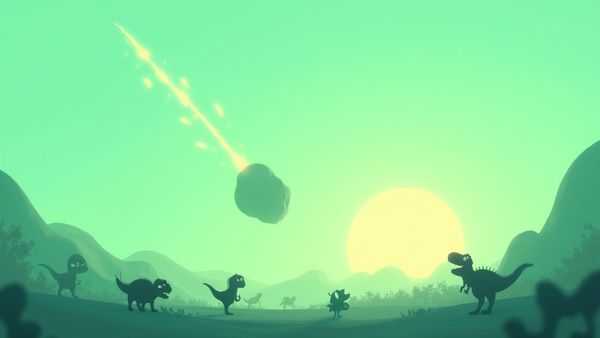
They figured out that a massive asteroid—maybe 10 to 15 kilometers wide—smashed into Earth! This giant space rock hit near what is now the Yucatán Peninsula in Mexico, creating the enormous Chicxulub Crater.
The Chain Reaction of Doom
The impact itself was instantly devastating for miles around, causing massive heat and giant waves called tsunamis. But the real killer was what happened next, high up in the air.
The crash threw a HUGE amount of dust, rock, and soot into the atmosphere, completely surrounding the Earth like a thick, dark blanket. This blocked out the sunlight for months, or maybe even years!
No sun meant no photosynthesis for plants on land and for tiny ocean plankton—the very bottom of the food chain! Without plants, the plant-eaters (herbivores) starved, and then the meat-eaters (carnivores) who ate them starved too. It was a devastating chain reaction for kids to learn about!
💡 Did You Know?
While the asteroid impact is the top suspect, some scientists think massive, long-lasting volcanic eruptions in an area called the Deccan Traps in India may have also contributed by pumping harmful gases and ash into the air around the same time!
🎯 Quick Quiz!
What element, rare on Earth but common in asteroids, was found in a global layer of rock that helped scientists prove the asteroid impact theory?
Who Survived and Why?
If the world turned dark and cold, who managed to survive the K-Pg event?
The survivors were often the ones who were small, could hide, and didn't need much food. Mammals, which were mostly small, shrew-like creatures scurrying in the shadows during the age of giants, mostly survived and had the chance to grow bigger later.
- Modern Birds: The one surviving lineage of dinosaurs! They could fly to find new spots, and some could eat seeds that lasted longer.
- Small Mammals: They could burrow underground, eat insects, seeds, and dead things, meaning they didn't need the huge supply of fresh leaves the big dinosaurs needed.
- Turtles and Crocodiles: These reptiles are cold-blooded (ectothermic) and can slow their bodies down, sometimes surviving for months without a big meal.
- Insects and Some Plants: Seeds and insect cocoons can wait out bad times much longer than a big animal can!
The Cretaceous Extinction Event was a total reset button for life on Earth. While it was a terrible tragedy for the mighty dinosaurs who ruled for so long, it opened up all those empty spaces in the ecosystem for new life to evolve. It’s the reason we have the world of mammals and birds we see today!
Questions Kids Ask About Prehistory
Keep Exploring the Prehistoric Past!
Wow, what a story! From giant dinosaurs to a world-changing asteroid, the Cretaceous Extinction Event is one of the most exciting (and sad!) chapters in Earth's history. Keep listening to 'History's Not Boring' to find out what amazing creatures walked, swam, and flew in the time before this huge change!