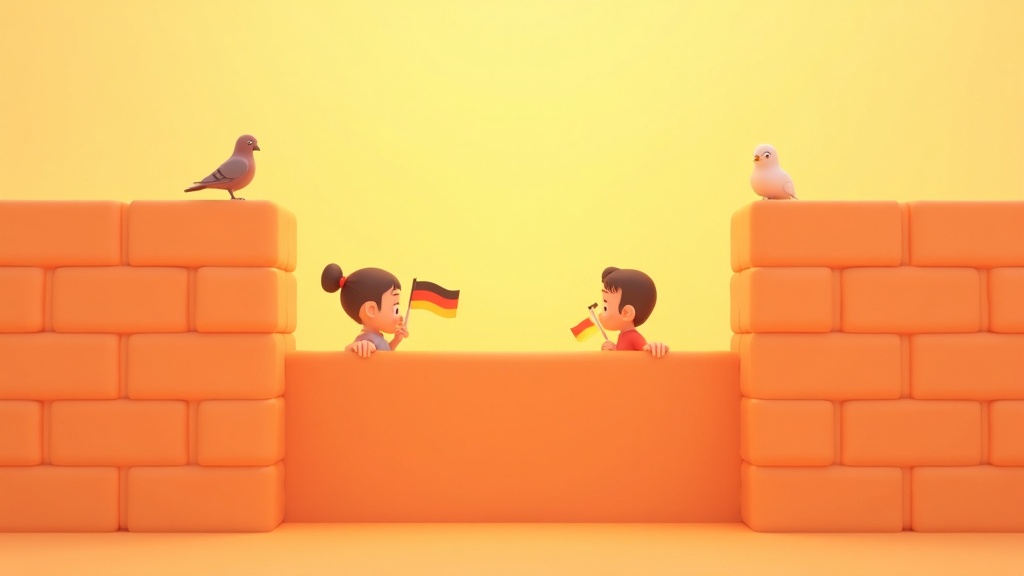

The Berlin Wall was a heavily fortified barrier built by East Germany starting August 13, 1961, to stop citizens from fleeing to democratic West Berlin. It stretched 155 kilometers, isolating West Berlin like an island. This divided city shows how political disagreements can impact everyday families.
Imagine waking up one morning, and suddenly, there’s a giant wall where your favorite playground used to be—and you can’t visit your grandma who lives just a few streets away! That’s what happened in the city of Berlin, Germany, when the Berlin Wall went up.
After World War II ended in 1945, Germany was split into two main parts: East Germany (controlled by the Soviet Union) and West Germany (supported by the US, UK, and France). Berlin, the capital city, was also divided, even though it sat deep inside East Germany. Things got tense between the East and West—this time of big disagreements was called the Cold War. To stop a massive movement of people leaving the East, the East German government started building the Berlin Wall on August 13, 1961!

Mira says:
"It’s hard to believe a wall could separate families for so long! Learning *why* they built something so sad helps us understand why tearing it down was such a huge, happy moment in history for kids and grown-ups alike."
What Was the Big Problem in Berlin?
Before the Wall, life in West Berlin felt much freer and more exciting than in East Berlin. West Berlin was like a little island of democracy and fun right inside communist East Germany!
Because of this difference, millions of East Germans—including many skilled workers, doctors, and teachers—decided they wanted to escape to the West to find better lives. They often used the open border in Berlin to make their move.
By 1961, East Germany was losing too many people—nearly 20% of its population had already left! The leaders in East Germany were worried their country would not survive if everyone kept leaving, so they decided to take a drastic step.
Mind-Blowing Fact!
The very first version of the Berlin Wall, put up overnight on August 13, 1961, wasn't even a solid wall—it was just miles and miles of barbed wire fencing!
How Big and Scary Was the Final Wall?
The Berlin Wall became much more than just a fence over time. It turned into a super-fortified barrier system that was 155 kilometers (about 96 miles) long around West Berlin!
It wasn't just one wall, but layers of fences, ditches, metal strips, and even concrete walls that could be over 11 feet (3.5 meters) tall!
This whole area between the inner and outer walls was called the 'death strip'. It was covered in soft sand so guards could see footprints, and it was patrolled by armed guards who were allowed to shoot anyone trying to cross.
(96 miles)
(By 1989)
(1961 to 1989)
How Did They Build Such a Massive Barrier So Quickly?
The building started in secret in the middle of the night! The East German government used soldiers and workers to quickly put up the initial barriers.
The first step was to use barbed wire and barricades to physically block all the roads, rail lines, and subway tunnels connecting East and West Berlin. This stopped the flow of people immediately.
After the initial surprise, the concrete blocks and guard towers were added over the next few years. This meant that people were suddenly cut off from friends, jobs, and family right in the middle of their own city.
What Were the Layers of Defense?
The Outer Wall: The big, scary concrete wall that people see in photos.
The Death Strip: A wide, open, unlit area designed to make escape impossible without being seen.
The Inner Wall/Fences: Additional barriers, signal fences that set off alarms, and watchtowers where armed guards kept watch 24/7.
💡 Did You Know?
The East German government officially called the wall the 'Anti-Fascist Protection Rampart'! They claimed it was to keep 'fascist elements' from the West out, but everyone knew its real job was to keep East Germans *in*.
🎯 Quick Quiz!
What was the main, secret reason the East German government built the Berlin Wall?
Who Was Affected by the Wall?
The Berlin Wall separated an entire city. Families were split up instantly, and people who worked on one side but lived on the other suddenly couldn't go to their jobs anymore. It was a huge heartbreak for millions.
While many tried to flee, it was incredibly dangerous. Sadly, historians estimate that between 136 and over 200 people were killed trying to cross the Wall during the 28 years it stood.
- Commuters Disrupted: About 60,000 people commuting between East and West Berlin for work were immediately cut off.
- Escape Attempts: Over 5,000 people successfully escaped over or under the Wall to freedom in the West.
- The Final Structure: The concrete segments of the final wall were often about 12 feet high (as tall as two grown-ups stacked up!).
Even though the wall stood for almost three decades as a harsh symbol of the Cold War, it couldn't last forever. The desire for freedom was too strong, and eventually, the people's movement caused the government to open the gates, leading to its fall in 1989! The story of *why* it was built helps us celebrate even more when we learn about *how* it finally came down.
Questions Kids Ask About Modern History
Keep Exploring the History of Walls and Freedom!
The Berlin Wall shows us how powerful ideas like freedom can be, even against a giant concrete barrier! Keep listening to History's Not Boring to find out more amazing stories about how people fought for a better world for kids just like you!