The Vikings were fierce warriors, brilliant sailors, and creative mythologists from Scandinavia who dominated the seas from the 700s to the 1000s AD. They believed in powerful gods like Odin and Thor, built incredible longships that could cross oceans, and reached North America 500 years before Columbus. Their mythology gave us the names for four days of the week.
Have you ever heard of explorers who sailed the wildest seas in dragon-headed ships, believed in gods who threw lightning bolts, and traveled farther than almost anyone else in their time?
Get ready to learn about the Vikings! These fierce, fascinating people came from Scandinavia (modern-day Norway, Sweden, and Denmark) during the Viking Age, which lasted from about the late 700s to the mid-1000s AD. While you might think of them only as warriors, Vikings were also amazing sailors, traders, and adventurers who explored huge parts of the world. They sailed across the ocean to trade furs and amber and even reached the shores of North America almost 500 years before Columbus! In this guide, you'll meet the mighty Viking warriors, explore the incredible world of Norse mythology, and discover the amazing ships that made it all possible!

Mira says:
"Wow, Finn! I can't believe they sailed all the way to North America! Their ships must have been super strong to handle the huge ocean waves. And I learned that Vikings didn't actually wear horns on their helmets — that's a myth!"
Who Were the Vikings?
The Vikings sailed from their homelands in Scandinavia between the late 700s and the 1000s to raid, explore, trade, and settle new lands. While we often picture them as terrifying warriors, that's only part of the story! Most Vikings were actually hardworking farmers who loved their families and their land.
They were also brilliant builders and expert sailors who explored farther than almost anyone else at the time. Their travels created an incredible network of routes that stretched from the cold North Atlantic to the warm Middle East! They set up trade centers and settlements in places like Ireland (founding Dublin!), France (where they became known as the Normans), and even Russia where they were called the Varangians.
The main span of the Viking Age
Leif Erikson reaches North America
Of Viking longships under sail
Erik the Red took to settle Greenland
Viking Warriors
Viking warriors were famous for being fierce and brave in battle. They had a strong social structure that included kings, powerful earls, and freemen who owned their own land. When war was declared, the free men were expected to gather their own weapons and fight to defend their clan or king.
They loved close-up fighting and often preferred using an axe or a sword over shooting arrows from far away. A crucial part of their mindset was the belief that dying bravely in battle meant they would go to Valhalla, a special warrior heaven ruled by the god Odin. This belief made them absolutely fearless!
Mind-Blowing Fact!
Some Viking warriors had a super-intense fighting style! They were called berserkers, and they would go into a wild, trance-like frenzy, howling and even wearing bear or wolf skins to scare their enemies. They were considered the elite fighters!
Viking Weapons and Armor
Viking warriors often carved runes (their alphabet letters) onto their swords and shields. They believed these magical letters would give their weapons extra strength and luck in battle! Despite what you see in movies, Vikings did NOT wear horned helmets. They wore simple leather or iron bowl-shaped helmets, often with a nose guard — practical protection for quick fighters on the move.
Life at Home: When Warriors Were Away
Even though the warriors were famous, most Vikings spent their time doing regular jobs. Farmers grew crops like barley, rye, and oats, and kept animals. Viking women were incredibly busy — they ran the home, cooked, wove all the cloth needed for clothes and sails, and managed the farm while the men were away raiding. One surprising thing about the Vikings is that they were actually very clean, bathing at least once a week — much more often than many other Europeans at the time!

Norse Gods and Mythology
Norse Mythology is the collection of stories and beliefs from the ancient Vikings. These myths explained the world around them — why the sun moved, what caused storms, and what happened after people died. It's basically the ancient superhero collection of Northern Europe!
The Vikings believed their gods belonged to two main groups: the Aesir (the main warrior gods, like Odin) and the Vanir (gods connected to nature and magic, like Freyr and Freyja). They all lived in a place called Asgard, which was connected to our world, Midgard, by a sparkling rainbow bridge called the Bifrost.
Mind-Blowing Fact!
You probably see Norse Mythology every day! Four of our days of the week are named after Norse gods: Tuesday (Tyr), Wednesday (Odin), Thursday (Thor), and Friday (Freyja)!
Yggdrasil: The World Tree
The center of the Norse universe wasn't a planet — it was a massive, magical ash tree called Yggdrasil (say: IG-dra-sill). This tree was so huge its branches reached up into the heavens and its roots stretched down into the deepest, darkest places. Yggdrasil held nine different worlds in its roots and branches, all connected! The gods even believed it was alive and growing.
The Most Famous Norse Gods
The stories are packed with unforgettable characters! Here are the biggest names:
- Odin: The Allfather, ruler of the Aesir. He is the god of wisdom, war, poetry, and magic. He has two ravens that fly all over the world to bring him news! Odin once hung himself from Yggdrasil for nine nights to gain the secret of the runes, and traded one of his eyes for wisdom.
- Thor: The big, strong God of Thunder! He carries the mighty hammer Mjollnir and is the protector of humans against the giants.
- Loki: The famous trickster! He's a shape-shifter who causes chaos but sometimes helps the gods out of a jam. He is the most mischievous god of all.
- Heimdall: The super-guardian of the gods. He watches over the Bifrost bridge and has hearing and eyesight so sharp he can hear grass grow!

💡 Did You Know?
The myths also tell the story of Ragnarok, which is like the world's ultimate battle — the final fight where the gods and giants clash and the world will eventually be destroyed and then reborn. Even heroes have an end, but new beginnings always follow!
Viking Ships and Raids
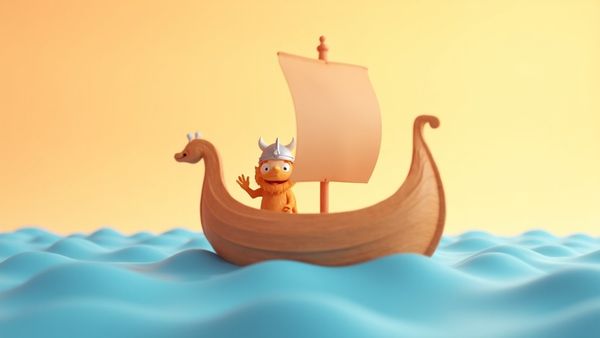
You can't talk about Vikings without talking about their incredible ships! The most famous Viking invention is the longship. These boats were built almost entirely out of oak wood and designed for speed and adventure.
Viking shipbuilders were masters! They used something called the 'clinker method,' where they overlapped the oak planks like roof shingles and nailed them together with iron rivets. To stop leaks, they stuffed the gaps with wool or animal hair and sealed it with sticky tar.
Why Were Viking Ships So Special?
Unlike many other ships, longships had a very shallow draft, which means they didn't sit deep in the water. This meant they could cross the rough, deep ocean AND sail up shallow rivers where no one expected them — perfect for surprise raids! The largest warships, called skeid, could be over 40 meters (131 feet) long and carry 60 or more warriors. They used big square wool sails when the wind was blowing, or dozens of oars when it wasn't.
(45 to 75 feet)
On the largest warships
(Under ideal weather)
The start of the Viking Age
Mind-Blowing Fact!
Viking ships had flat bottoms! This meant they could sail in very shallow water — sometimes just a meter deep — and land right on the beach. This made it easy to launch a surprise raid and then quickly escape!
The Famous Raids
The Viking Age truly kicked off with a shocking raid on the Lindisfarne Monastery in England in 793 AD. This was a huge shock to Christian Europe — a sudden, large-scale attack on a peaceful holy site!
- Early Raids (Late 700s): Swift, hit-and-run attacks targeting wealthy, undefended monasteries, like Lindisfarne.
- Invasions (Mid-800s): The raids became bigger. The Great Heathen Army landed in England in 865 AD, showing they wanted to conquer and settle, not just loot!
- Major Targets: Vikings attacked all over! They founded Dublin in Ireland (840 AD), sacked Paris (845 AD), and even reached Constantinople (modern-day Istanbul).
How Did Vikings Navigate?
The Vikings were masters of navigation without any technology! They used the sun during the day and the stars at night to keep a straight course. They watched for birds, the color of the water, and the direction of waves. For tricky cloudy days, some ships likely used a special crystal called a sunstone to locate the sun's position through the clouds! They also carried trained ravens to guide them to land when they were close.
💡 Did You Know?
Viking ships were so important that when a powerful chief died, his magnificent longship was sometimes buried with him as a final resting place, often covered with earth to create a massive burial mound!
Famous Viking Explorers
The Viking Age is filled with legendary names! The biggest explorers sailed west, settling new lands across the North Atlantic.
- Erik the Red: After being exiled from Iceland for a fight, he sailed west and discovered and settled Greenland around 985 AD! He set out with 25 ships, though only 14 made it.
- Leif Erikson: The super-famous son of Erik the Red! Around the year 1000 AD, he sailed even farther west and became the first known European to set foot on North America, which he called Vinland because of the wild grapes growing there.
- Bjarni Herjolfsson: Legend says he was the first Viking to accidentally see North America when he got blown off course sailing to Greenland — a few years before Leif Erikson's famous voyage!
🎯 Quick Quiz!
What did Leif Erikson famously name the part of North America he explored?
🎯 Quick Quiz!
What was the special afterlife place the Vikings believed brave warriors went to after death?
Even after the Viking Age officially ended around 1066 AD with the Battle of Stamford Bridge in England, the spirit of adventure lived on. The Vikings weren't just raiders — they were brave pioneers who shaped maps, created trade routes that lasted for centuries, built ships that were engineering marvels, and imagined a mythology so powerful we still name our days of the week after their gods. From the thunder of Thor's hammer to the creak of a longship's oars, the Viking legacy lives on!
Questions Kids Ask About Medieval History
Keep Exploring the Seas of History!
From their incredible dragon-headed longships to the thunder of Thor's hammer, the Vikings were true pioneers of the Medieval world. They sailed farther, fought harder, and imagined bigger than almost anyone else in their time. What other incredible adventurers from history will you discover next? Keep listening and learning!