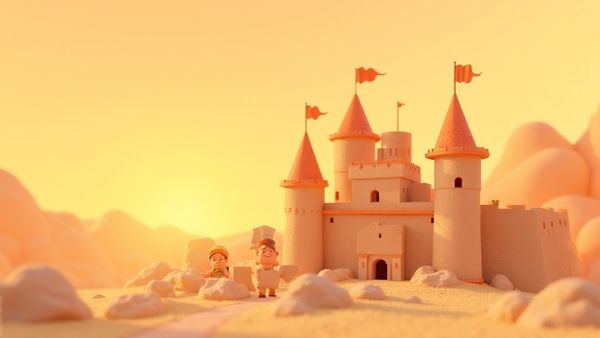
Medieval castles were massive stone fortresses built for defense during the Middle Ages, often taking 2–10 years to complete. They were built using locally sourced stone and mortar made from burnt limestone. See how these strongholds were constructed for protection!
Imagine a giant fortress, made entirely of rock, standing tall for hundreds of years. How on earth did people build those massive medieval castles without cranes, trucks, or even power tools?
Castles were the ultimate strongholds of the Middle Ages, built to protect kings, queens, and their people from attack. In the early days, they started as simple wooden forts, but people quickly learned that wood was too easy to burn down! By about 1100 CE, builders switched to stone to create structures that could truly withstand a siege. Building these stone behemoths was an enormous job that took years, sometimes even a decade, and required thousands of workers!

Mira says:
"I can’t believe they built something so huge without digging machines! They had to be experts at planning, or their walls would just crash down. It’s like super-advanced ancient LEGOs!"
What Were the Best Spots for a Castle?
Before a single stone was laid, the lord and the Master Builder had to pick the perfect spot. Why? Because location was the first line of defense! They needed a place where nature helped do the hard work.
The absolute favorite place was on top of a hill or a high cliff. This gave guards an amazing view to spot enemies coming from miles away. If a hill wasn't available, they sometimes chose spots near rivers or harbors, using the water as a natural ditch to slow down attackers.
Mind-Blowing Fact!
The earliest castles were actually built from wood in what's called the 'motte-and-bailey' style! The motte was a man-made hill the wooden tower sat on, and the bailey was the courtyard below.
The Big Three Building Materials
Real castles were made from what was nearby! Generally, the main building material was stone, usually limestone or sandstone, sourced from a nearby quarry—sometimes less than 10 miles away.
If you were building a castle today, you'd need cement, but back then, they used mortar to glue the stones together. This was made by burning limestone or chalk to create quicklime, which was then mixed with sand and water.
Finally, timber (strong wood like oak) was crucial for roofs, scaffolding, the drawbridge, and lifting machines. A castle project needed endless supplies of wood and stone!
To build a typical castle
Employed on big castle projects
(In some major fortresses)
Transport often cost more than the stone itself!
How Did They Move the Giant Stones?
Once the rock was quarried (dug out of the earth), it needed to get to the building site. Transporting stone was expensive—sometimes it cost more than the stone itself because they used slow, heavy horse-drawn carts!
The lucky ones built their castles close to a river so they could float the stone on boats. Unlucky builders had to haul it over bumpy dirt roads.
Step 1: Digging Deep Foundations
Builders first dug deep trenches down to the firm bedrock—the solid rock underneath the soil. This was super important so the heavy walls wouldn't sink or wobble! If they couldn't reach bedrock, they filled the trenches with tightly packed rubble and mortar to make a solid base.
Step 2: Raising the Walls Layer by Layer
The stone was shaped by skilled masons using chisels. For the thick walls, they used two different types of stone: Ashlar (smooth, neatly cut stone) for the outside and inside faces, and cheap rubble (mixed irregular stones and mortar) to fill the gap in the middle. They laid the stones in horizontal layers called courses, making sure the outside stones were perfectly aligned using levels and plumb lines!
Step 3: Lifting the Stones
How did they get those heavy stones way up high? They used man-powered cranes! These weren't the metal cranes we see today; they were often giant wheels called treadmills. A worker walked inside the wheel, turning it, which powered ropes and pulleys to hoist the stone up to the scaffolders working on the wall.
💡 Did You Know?
When the walls got taller, scaffolding beams were inserted directly into holes left in the wall. When the castle was finished, these holes were often left as square gaps, which are sometimes still visible today!
🎯 Quick Quiz!
What material was primarily used to fill the empty space inside very thick castle walls?
Why Were Some Towers Round Instead of Square?
Early square towers were easier to build, but attacking armies figured out how to knock down the corners easily. Over time, builders realized that round towers were much better at defending the castle!
Round towers don't have those weak corners, and they are much better at deflecting things thrown by siege weapons like catapults.
- Battlements (Crenellations): The zig-zag pattern at the top of the wall. The high bits (merlons) protected the archers, and the low bits (crenels) let them shoot.
- Arrow Slits (Loops): Very narrow vertical slits in the wall that let archers shoot out while making it super hard for an enemy to shoot back in.
- Machicolations: Projecting stone galleries on the outside of the wall with holes underneath, perfect for dropping rocks or boiling liquids right onto attackers below!
It took incredible math skills, teamwork, and sheer muscle power to build these structures. Even though they were drafty and damp inside, these stone castles were the toughest pieces of architecture in the world for centuries, showing off the power of the people who lived inside them!
Questions Kids Ask About Medieval History
Keep Exploring the Past!
Now you know the amazing engineering that went into making a medieval castle stand strong against its enemies! Next time you see a picture of one, remember the thousands of workers, the heavy stones, and the clever designs that made history's greatest fortresses! What other giant building projects should we explore next?