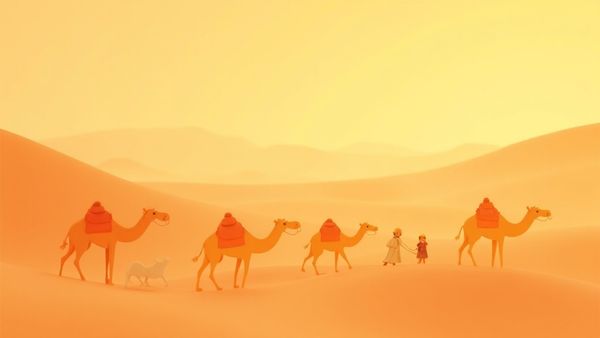
The Silk Road was a massive network of trade routes connecting ancient China to Europe and the Mediterranean Sea, active from the 2nd century BCE. The main land route stretched about 4,000 miles! These brave traders shared valuable goods and ideas across continents.
Imagine a path so long it connected huge empires, like a giant, ancient superhighway that stretched across deserts and mountains for thousands of miles!
This legendary path wasn't just one road—it was a whole network of routes called the Silk Road! It was active for centuries, starting around the 2nd century BCE and continuing until the mid-1400s. It earned its name because one of the most amazing things traded along it was silk, a beautiful, soft fabric only the Chinese knew how to make. But these brave traders carried much, much more than just silk between the East and West! For kids learning about history, this is one of the most exciting ways people shared culture and goods a long, long time ago.
Mira says:
"Wow, Finn! Can you imagine carrying precious porcelain or heavy gold across a desert? These traders were super strong and super smart to keep those long journeys going!"
What Was the Silk Road, Anyway?
The Silk Road wasn't like the paved road outside your house. It was a massive system of trade routes that connected China in the East to the Mediterranean Sea and Europe in the West. Think of it as a collection of dusty trails, mountain passes, and even sea lanes that worked together.
The main land route stretched for about 4,000 miles (or 6,400 kilometers)! That’s like driving from New York City all the way past Los Angeles and back again, but on a bumpy, ancient path! The journey was often broken into smaller pieces; usually, a trader would carry goods a short distance, sell them, and then a new trader would take over, like passing a giant baton in a relay race.
Mind-Blowing Fact!
The name 'Silk Road' was actually made up much later, in the 1870s, by a German geographer named Ferdinand von Richthofen, just because silk was such a famous export!
More Than Silk: What These Traders Carried
If the road was named for silk, you know that was a huge deal! The Chinese kept the secret of making silk a closely guarded treasure for hundreds of years. Rich people in Rome loved it so much they paid huge amounts of gold for it!
But the traders were busy carrying tons of other amazing stuff in both directions. Imagine mountains of colorful spices, beautiful porcelain dishes, and even tea heading west. Heading east, traders brought back things like powerful horses, fine glassware, and wool.
(6,400 km)
to buy Chinese silk!
during the Han Dynasty
in the East
How Did They Survive the Journey?
The Silk Road was famous for being tough! Traders had to cross massive, hot deserts like the Gobi, and climb over towering, icy mountains called the Pamirs. It was dangerous because of bandits, scary weather, and just being so far from home.
So, how did they manage? They relied on incredible animals and teamwork!
The Best Transport Animals
For the dusty, dry land routes, the most important animal was the camel! Camels are like nature's own desert trucks. They can carry heavy loads and go for days without water, making them perfect for crossing long stretches of sand.
The Relay Race Method
Very few traders actually traveled the entire 4,000 miles! Instead, they would trade in stages. A merchant might travel from China to a city like Samarkand, sell his goods, and then return home. Then, a Central Asian merchant would buy those goods and carry them to the next stop, maybe Persia. This passing of goods, known as 'relay trade,' kept the whole system moving!
💡 Did You Know?
Besides materials, the Silk Road also traded *ideas*! Things like math, science, inventions (like paper and gunpowder from China!), and major religions, including Buddhism, Christianity, and Islam, traveled along these same dusty paths.
🎯 Quick Quiz!
Which animal was the superhero of the desert parts of the Silk Road because it could go a long time without water?
Who Were the Most Famous Travelers?
While thousands of merchants walked these routes, one name rings out through history: Marco Polo! He was a Venetian (from Italy) merchant who traveled to China—or 'Cathay' as he called it—with his father and uncle.
Marco Polo started his epic trip in 1271 and spent 24 years exploring the East, even serving the powerful Mongol ruler, Kublai Khan! His book about his adventures gave Europeans their first detailed look at the incredible wealth and culture they were missing.
- Silk: The most famous item, leaving China for fancy robes in the West.
- Porcelain: Beautiful, thin pottery that was highly prized in Europe.
- Spices: Like cinnamon and pepper, making food taste amazing!
- Horses: Strong Central Asian horses were wanted by Chinese armies.
- Ideas: Knowledge about math, art, and religion moving both ways.
The Silk Road wasn't just about getting rich; it was about connecting people! It showed everyone how different and amazing the world was, even across massive distances. Think of those ancient traders as the first truly global connectors, bringing the whole world a little bit closer for kids and adults alike!
Questions Kids Ask About Explorers
Keep Exploring the Trade Routes!
The bravery of those Silk Road traders changed history forever! They proved that even across huge mountains and scary deserts, people want to share and connect. Next time you see something imported, remember the incredible journeys those items might have taken thousands of years ago!