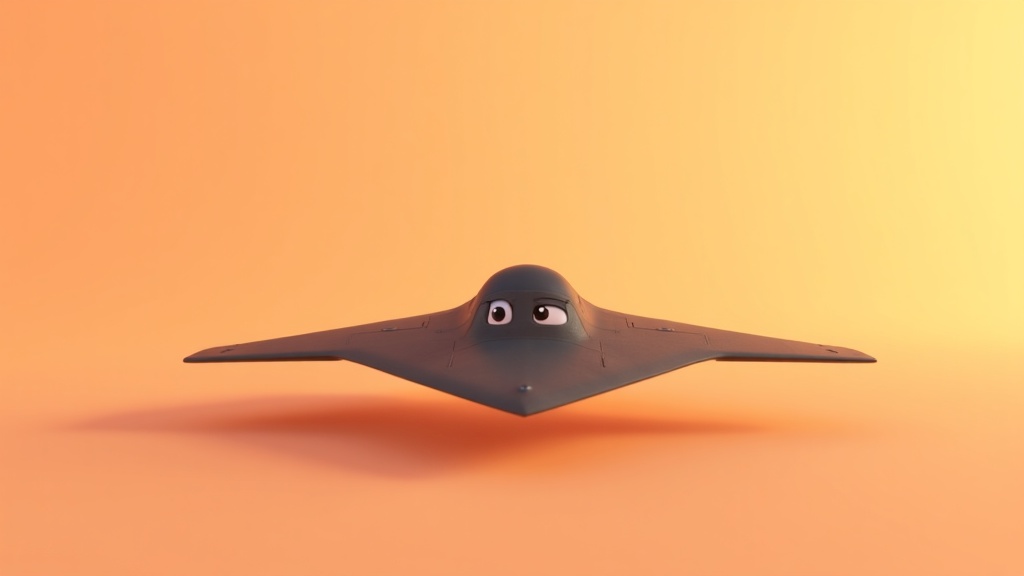

Stealth planes use Low Observability Technology (LOT) to become hard to spot by radar. They use sharp angles to deflect radar waves away from the source, making them nearly invisible. Some stealth aircraft have a tiny Radar Cross Section (RCS) as small as 0.001 m²! It’s like magic science for secret missions.
Imagine an airplane so sneaky, it could fly right past enemy defenses without *anyone* even noticing it was there! How is that even possible?
Welcome to the amazing world of stealth planes! These aren't your average airplanes; they are like the ninjas of the sky. Stealth technology is a mix of cool science and clever engineering that makes these aircraft very hard to spot using tools like radar or heat sensors. The goal is Low Observability Technology (LOT), which means making the plane as unnoticeable as possible to keep secret missions safe!

Mira says:
"I read that the very first operational stealth plane was the F-117 Nighthawk! It was designed back in the 1970s just to avoid those tricky enemy missiles. Talk about being ahead of your time!"
What is Radar, and How Do Planes Usually Get Caught?
To understand stealth, you first need to know about radar! Think of radar like a giant, invisible echo-locator, similar to how a bat or a dolphin finds things. A radar machine sends out a pulse of radio waves into the air.
If those radio waves hit something big, like a regular airplane, they bounce right back to the radar station. When the waves come back, the radar machine shouts, 'Aha! There’s an object here!' and you show up on their screen.
Stealth planes are built to stop that bounce! They use amazing tricks to make sure those radio waves either don't hit them directly, or that they bounce away in a completely different direction, like throwing a ball against a wall that sends it sideways instead of back to your hand.
Mind-Blowing Fact!
The first plane designed specifically to be hard to find using radar was actually the German Horten Ho 229 made way back in 1943 during World War II!
The Super-Shapes and Special Skins of Stealth
It’s not just one trick, but a whole team of them working together! Stealth planes look strange—not like the smooth planes you see at the airport. Their bodies are covered in sharp angles and flat surfaces. This special shaping is key to deflection.
When radar waves hit these flat, angled surfaces, they are redirected away from the radar receiver, making the plane look like a tiny flicker or nothing at all! This geometry is super important.
Next up are the materials! Stealth aircraft are covered in special coatings called Radar-Absorbent Material (RAM). Instead of bouncing the radar waves back, the RAM soaks them up—like a giant sponge for radio waves—and turns the energy into harmless heat.
About the size of an eagle's eyeball!
Nearly as wide as the White House!
Weight of bombs it can carry while staying hidden.
How Do Stealth Planes Hide Their Hot Spots?
Enemies don't just use radar; some also look for heat, especially from the powerful jet engines! If an engine is too hot, it leaves a trail in the sky that heat-seeking missiles can follow. Stealth designers have to hide this heat, too!
Stealth planes cool down their exhaust by spreading it out over a wider area or mixing the super-hot air with cooler outside air before it leaves the plane. This makes the plane’s heat signature much smaller and harder to track with infrared sensors.
The Three Big Rules of Stealth Flying
Even the coolest design needs a good pilot! To stay hidden, pilots must follow strict rules: Always fly smoothly. Sharp turns or sudden movements can mess up the perfect radar-deflecting shape.
Keep the doors closed! Bomb bays and landing gear doors have to stay shut tight. Opening them for even a second can create a flat surface that screams 'I'm a plane!' to enemy radar.
Be careful what you broadcast! Pilots must limit the use of bright lights or powerful radios, because those signals can also give away their secret location.
💡 Did You Know?
Because they are built for stealth, some early planes like the F-117 were actually not very good at flying smoothly on their own—they needed super-fast computers to constantly make tiny adjustments to stay in the air!
🎯 Quick Quiz!
What is the main job of Radar-Absorbent Material (RAM) on a stealth plane?
Why is Being Invisible So Important for History?
Stealth technology is all about giving military forces the ability to strike at important targets deep inside enemy territory without being seen. If you can get in and out without being detected, you can complete your mission much more safely.
It’s a huge advantage because it makes old defense systems almost useless! This powerful 'invisibility' acts as a strong deterrent, meaning it can sometimes stop conflicts before they even start just because the enemy knows they can't see you coming.
- F-117 Nighthawk: The first plane truly famous for its faceted, angular stealth look, designed to break up radar.
- B-2 Spirit: A giant 'flying wing' that has no tail, which helps it scatter radar waves everywhere *except* back to the source.
- B-21 Raider: The newest generation of stealth bomber, designed to be even harder to spot than its famous relatives!
The next time you see a picture of a modern stealth fighter, remember it’s not magic—it’s brilliant history in action, combining strange shapes, special paint, and super-smart engine design to become the ghost of the skies!
Questions Kids Ask About Military History
Keep Exploring the Skies!
You’ve unlocked the secrets of how these amazing airplanes master the art of hide-and-seek! History is full of incredible inventions, and stealth technology is one of the most mind-blowing. What other secrets of the sky do you think future planes will have?