The Titanic was a magnificent ocean liner that sank on April 15, 1912, after hitting an iceberg on its maiden voyage. About 1,500 of 2,224 people aboard were lost. The heroic ship Carpathia raced 58 miles through icy waters to rescue 712 survivors. Captain Edward J. Smith went down with his ship. The disaster changed maritime safety forever.
Did you know there was once a ship so HUGE it was nicknamed the 'Ship of Dreams' — and people believed it could never sink?
The RMS Titanic was the biggest, fanciest ocean liner ever built when it set sail on April 10, 1912. But just four days into its very first voyage, disaster struck in the icy Atlantic Ocean. In this guide, you'll discover amazing facts about the Titanic's incredible size, learn exactly how it sank, meet the brave captain and survivors, and find out how a hero ship called the Carpathia raced through icebergs to save hundreds of lives. Buckle up — this is the complete Titanic story for kids!

Mira says:
"Wow, this ship was like a floating luxury hotel! Imagine having a swimming pool AND a Turkish bath all on a boat! We need to learn how big things were back then to really understand the Titanic."
What Made the Titanic So Special?
The Titanic wasn't built just to get from England to America; it was built to be the most luxurious way to travel! It had amazing features that most other ships didn't have. People traveled in three different 'classes': First, Second, and Third Class. First Class passengers had the best of everything, like fancy dining rooms and a real swimming pool! Even the Third Class cabins were nicer than other ships' cabins.
It was a floating city designed for comfort and elegance, not just speed. The White Star Line, the company that owned the Titanic, wanted to be the best by making the biggest and most beautiful ship. This made it a legend even before it ever left the dock!
Mind-Blowing Fact!
The Titanic had an incredible Grand Staircase that went down through many floors! It was super fancy with glass and iron, like something out of a fairy tale castle, but on a ship!
Titanic by the Numbers: Amazing Scale!
To understand just how big the Titanic was, we need to look at some big numbers. This ship was a giant! Think about the biggest things you know — it was bigger than that!
Its total length was about 883 feet (that's nearly three football pitches lined up!). The ship was 92 feet wide and had ten decks — like a giant apartment building floating on the water. It had nine decks for passengers to explore, plus cool features like a swimming pool, a gym, and fancy dining rooms.
(269 meters)
(Approx. Passengers & Crew)
(Capacity for only 1,178)
(But only 3 actually worked!)
How Did the Titanic Set Sail?
Building a ship this big took a lot of time and amazing teamwork. The very first step was laying the keel, which is like the ship's backbone. The first keel plates were laid down on March 31, 1909 in Belfast, Northern Ireland! From there, massive steel plates were added to form the hull — the outside body of the ship. It took over two years of hard work by thousands of people to build it.
Once the hull was finished and launched in May 1911, the real inside work began — called 'fitting out.' Workers installed all the engines, beautiful wood paneling, and all the fancy furniture. Finally, the ship passed 'sea trials' in early April 1912, and the Titanic was declared ready for its big adventure.
💡 Did You Know?
The Titanic was carrying mail, so it had the official title of RMS — which stands for Royal Mail Ship! It earned this title because it was contracted to carry letters and packages across the ocean.
How Did the Titanic Sink?
The Titanic set sail from Southampton, England, on April 10, 1912, heading for New York City. The journey was going well — but late on the night of April 14, 1912, everything changed. Even though lookouts spotted an iceberg ahead, the ship couldn't turn fast enough in the dark, calm water!
Instead of a head-on crash, the iceberg scraped along the starboard (right) side of the ship, tearing holes in the steel plates below the waterline. This created a long gash, letting freezing ocean water rush into the ship's lower sections.
The Compartments Fill Up
The Titanic was built to float even if up to four of its 16 watertight compartments flooded. Sadly, the iceberg damage opened up six compartments! As the front compartments filled, the ship started to tilt forward, causing the water to spill over the tops of the walls separating the other rooms. This was called 'progressive flooding.'
The Ship Breaks Apart
As the front (the bow) sank deeper into the water, the back (the stern) lifted high up in the air! The massive weight and strain caused the ship to break in half between the third and fourth funnels. After breaking apart, the two pieces sank to the bottom of the dark, freezing ocean. The whole sinking took just 2 hours and 40 minutes from the moment the iceberg struck.

Mind-Blowing Fact!
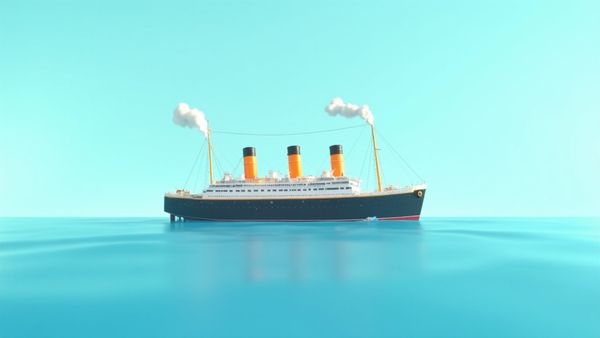
The Titanic had four big funnels (smokestacks), but only three of them actually blew out smoke! The fourth one was added mostly to make the ship look even bigger and more powerful.
Why Didn't More People Survive?
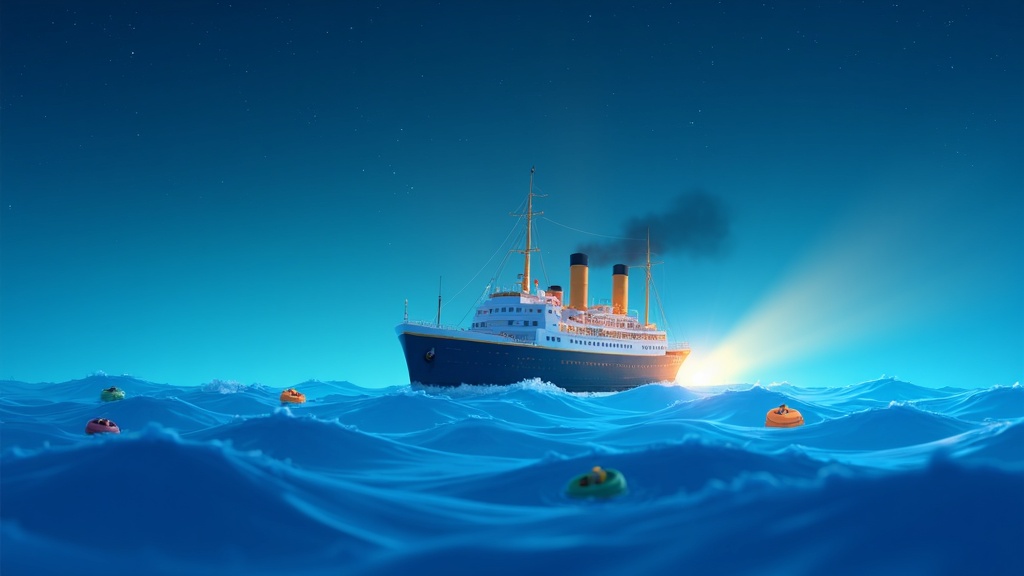
This is the saddest part of the story. Out of the estimated 2,224 people on board, around 1,500 did not survive. Even after hitting the ice, there weren't enough lifeboats for everyone. The Titanic only carried 20 lifeboats, which had room for about 1,178 people — only about half the people aboard!
- Launching Half-Empty: Because people were confused and afraid the boats would break, many lifeboats were lowered with lots of empty seats still available.
- Women and Children First: The rule was 'women and children first,' and most first-class women and children made it safely. Sadly, many people in second and third class did not get a spot in time.
- Freezing Water: The water temperature was close to -2°C (28°F)! Even people who made it into lifeboats faced huge danger from the icy conditions.
Because of this disaster, governments immediately changed the rules for big ships. New laws called SOLAS (Safety of Life at Sea) made sure ships always have enough lifeboats for every single person on board, plus better ways to send out distress signals and 24-hour radio watches!
Titanic Survivor Stories
Even though the sinking was a terrible tragedy, hundreds of people made it to safety — and their stories are incredible. About 706 survivors were rescued from the lifeboats, from tiny babies to brave crew members.

The Youngest Survivors
One amazing survivor was Millvina Dean, who was only nine weeks old when she sailed on the Titanic. She was wrapped up in a sack to keep warm and made it into Lifeboat Number 10! Millvina became the last living Titanic survivor before she passed away in 2009.
Another brave kid was Eva Hart, just seven years old when her father helped put her and her mother into Lifeboat Number 14. Sadly, Eva's father did not survive the sinking.
The 'Titanic Orphans'
One of the saddest but most heartwarming stories is about two little brothers, Michel Jr. and Edmond Navratil, often called the 'Titanic Orphans.' Their father put them into the very last lifeboat to leave the ship before he stayed behind.
The boys, aged two and four, didn't speak any English! Nobody knew who they were after the rescue. Luckily, their pictures were printed in newspapers all over the world. Their mom, back in France, saw the photo and traveled all the way to New York for a joyful reunion with her sons!
The Unsinkable Molly Brown
You might have heard of Molly Brown, nicknamed 'The Unsinkable Molly Brown'! After she got into Lifeboat Number Six, she insisted the sailors row back to look for more people in the water. She was a true example of kindness and refusing to give up hope when others were in danger.
💡 Did You Know?
One crew member, Violet Jessop, was so lucky (and good at staying calm!) that she also survived accidents involving the Titanic's sister ships, the Olympic and the Britannic! People called her 'Miss Unsinkable.'
Captain Edward Smith: The Man in Charge
The captain of the Titanic was Edward John Smith, often called Captain E. J. Smith. He wasn't just any sailor — he was one of the most experienced sea captains alive! Born in 1850 in England, Captain Smith had spent over 40 years working on the sea by the time he took charge of the Titanic at age 62.
He was so popular with the richest and most famous passengers that people nicknamed him the 'Millionaire's Captain.' He had commanded many ships on their maiden voyages, including the Titanic's sister ship, the Olympic.
Mind-Blowing Fact!
Captain Smith was planning for the Titanic to be his very last trip! He was supposed to retire from sailing forever once the ship made it safely to New York.
The Captain's Final Orders
Even though the Titanic received warnings about icebergs, the ship kept going at a fast speed — around 22 knots (41 km/h). When the iceberg struck, Captain Smith was quickly told the terrible news. He gave orders to get the lifeboats ready and to follow the rule: 'women and children first.'
He helped make sure the distress signals were sent out so other ships would know they needed help. Captain Smith was last seen on the bridge, doing everything he could for everyone aboard.
The Carpathia Rescue: A Hero Ship Arrives
While the Titanic was sinking, a smaller ship called the RMS Carpathia heard the desperate SOS distress call. The Carpathia belonged to the Cunard Line and was on a cruise heading from New York toward Europe. Her captain, Arthur Henry Rostron, didn't hesitate — he ordered the ship turned around and set a course straight for the Titanic's last known location.
This was incredibly risky because they were heading into a sea filled with the same icebergs that sank the Titanic!

The Race Against Ice and Time
The Carpathia was 58 miles (108 km) away when the distress call came in around 12:20 AM on April 15th. Captain Rostron ordered the crew to push the engines harder than usual, racing at about 17 knots — faster than the ship's usual top speed of 14 knots. He even had the heating turned off to save steam for the engines!
The Carpathia arrived at the sinking site around 4:00 AM, about an hour and a half after the Titanic went down. By then, the only things left floating were the lifeboats filled with survivors.
(108 km) away when the call came
Racing through the ice field
Pulled from the freezing lifeboats
How the Carpathia Crew Prepared
Captain Rostron didn't just drive fast — he prepared his ship to be the best possible safe haven. Dining rooms were turned into makeshift hospitals. Blankets, hot soup, and warm drinks were prepared. Passengers and crew on the Carpathia even gave up their own cabins so the Titanic survivors would have warm beds!
When the Carpathia finally arrived in New York City on April 18, 1912, thousands of people were waiting on the docks, cheering for the heroes who had brought their loved ones home safe.
🎯 Quick Quiz!
How many of the Titanic's watertight compartments were damaged by the iceberg?
Why Is the Titanic Story So Important?
The Titanic's sinking was a terrible tragedy, but it changed the world of sea travel forever. The survivors' experiences led directly to new safety rules that have saved countless lives since 1912. Ships now must carry enough lifeboats for everyone, hold regular lifeboat drills, and keep 24-hour radio watches.
The wreck of the Titanic was finally found deep under the ocean in 1985, at a depth of about 13,000 feet. And the Carpathia? She was torpedoed by a German submarine in 1918 during World War I — but even her final moments were heroic, as most of her crew survived. Her wreck was found in 1999.
The story of the Titanic reminds us that even the biggest, strongest things can face surprising challenges. From the brave captain who stayed on the bridge, to the tiny baby who survived in a lifeboat, to the hero ship that raced through the ice — this is a story of human courage, tragedy, and hope that kids and grown-ups will never forget.
Questions Kids Ask About Famous Ships
Keep Exploring History's Wonders!
The story of the Titanic reminds us that even the biggest, strongest things can have surprising challenges. It's a powerful piece of history! Keep listening to History's Not Boring for more amazing stories from the past!