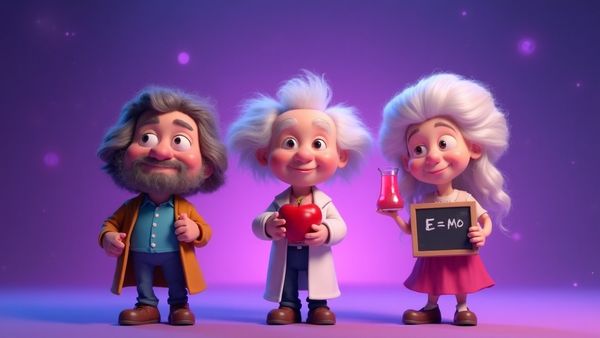
A scientist is a super-curious detective who observes the natural world, asks 'Why?' and 'How?', and tests ideas through experiments. Sir Isaac Newton, born in 1643, discovered gravity after watching an apple fall. Scientists help us understand everything from tiny atoms to faraway galaxies.
Have you ever wondered why you always fall back to the ground after a big jump, or what makes light bend around a huge star?
The world we live in today is full of amazing gadgets and mind-blowing knowledge, and we have super-smart people called scientists to thank! These amazing people, from history's past, asked the biggest questions and worked hard to find the answers. They gave us the laws of motion, explained how gravity works, and even discovered brand new elements! Get ready to meet some of the coolest thinkers for kids to ever live!
Mira says:
"It’s so cool how a simple question, like 'Why did that apple fall down?' can lead to a discovery that explains how the whole universe works! That's what science is all about!"
What is a Scientist and Why Do They Matter?
A scientist is like a super-curious detective for the natural world! They observe things, ask 'Why?' and 'How?', and then test their ideas again and again. They don't just guess; they use experiments and math to prove what they find out. Scientists push the world of knowledge forward, helping us understand everything from the tiniest atoms to the farthest galaxies.
Mind-Blowing Fact!
Many of the greatest scientists you’ll meet were told they were 'slow' or 'bad' at school when they were young! But they kept asking questions, and that curiosity changed history!
The Gravity Guru: Sir Isaac Newton
Let’s start with Sir Isaac Newton, an English scientist born way back in 1643! He was obsessed with how things moved. You might know the famous story: he was sitting under an apple tree when an apple fell down and *thunk*—it hit near him! Instead of just picking it up, Newton wondered: why did it fall *down* and not sideways or up?
This simple question led him to one of the biggest ideas ever: gravity! Gravity is the invisible force that pulls everything with mass toward everything else. It’s gravity that keeps your feet on the ground and keeps the Moon orbiting the Earth.
Newton figured these out!
When Newton was born
Affects everything in it
How Did Marie Curie Discover New Elements?
Next up is the amazing Marie Curie, born in 1867! She was a physicist and chemist who worked with a mysterious energy coming from certain materials. She decided to study this strange glow, which she named radioactivity.
Working with her husband, Pierre, in what was sometimes just a leaky shed, she was incredibly patient. They studied a rock called pitchblende and realized it was giving off WAY more radiation than the uranium inside it should have! They worked for years to separate out the tiny bits that were causing the extra glow.
The Trailblazing Discoveries of Madame Curie
Marie Curie’s hard work paid off with two huge discoveries: she found two brand-new elements for the periodic table!
1. Polonium: She named this element after her home country, Poland!
2. Radium: This element glows because it's so radioactive.
💡 Did You Know?
Marie Curie was the first woman to win a Nobel Prize, and even more incredibly, she is the *only* person ever to win Nobel Prizes in two different sciences (Physics and Chemistry)!
🎯 Quick Quiz!
What invisible force did Isaac Newton realize keeps the Moon orbiting the Earth?
Who is the Genius Behind E=mc²? Albert Einstein
Albert Einstein, born in 1879 in Germany, is probably the scientist you picture when you think of a genius! He used deep thinking and amazing math to figure out how the universe *really* works, especially about space, time, and energy.
His most famous idea is the equation E=mc². This might look tricky, but it just means that energy (E) and mass (m—how much 'stuff' is in something) are two sides of the same coin! A tiny bit of mass can turn into a HUGE amount of energy.
- General Relativity: Einstein explained gravity not as a force, but as the way heavy things bend the fabric of space and time, like a bowling ball on a trampoline!
- Photoelectric Effect: He won the Nobel Prize in Physics in 1921 for explaining how light acts like tiny packets of energy (called photons).
- Space-Time: His theories helped us understand that space and time are connected—it’s not just a big empty box everything sits in!
These scientists didn't just invent things you can hold; they changed the *rules* of science! Their deep thoughts are the foundation for everything from the rockets that go to space to the medicines that keep us healthy today. Keep asking big questions, future scientist!
Questions Kids Ask About Famous People
Keep Exploring Like a History-Making Scientist!
From an apple falling to glowing rocks, these famous scientists show us that history isn't just about kings and battles—it’s about brave minds asking 'What if?' Keep being curious in your own world, because you might just be the next person who changes everything!