
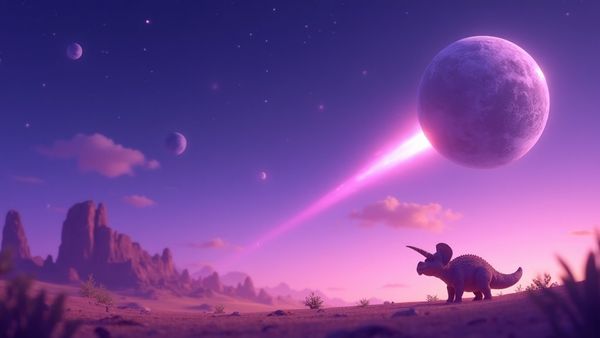
The asteroid that killed the dinosaurs was the Chicxulub impactor, a space rock estimated to be 10 to 15 kilometers wide. When it hit 66 million years ago, it caused a massive extinction event that wiped out 75% of life on Earth, ending the age of dinosaurs.
What if I told you a giant space rock was the reason we don't have T-Rexes stomping around today?
Get ready to blast back in time—about 66 million years ago! That’s when the age of the dinosaurs, which had lasted for millions of years, came to a sudden, dramatic end. Most scientists agree that the main culprit was a massive space traveler we call the Chicxulub impactor—a giant asteroid! This isn't just a small rock; this thing was truly enormous and caused one of the biggest changes in Earth's history. It was so powerful it triggered a mass extinction, wiping out about 75% of all plant and animal species on our planet. This amazing and slightly scary event is what marks the end of the dinosaur era in the rock layers we study today!

Mira says:
"It’s wild to think that something from space—something we can still see today—caused such a huge, final chapter for creatures like the Brachiosaurus. Think about that next time you look up at the stars!"
What Exactly Was This Dinosaur-Killing Asteroid?
The space rock that changed everything is famous! It’s named after the place it hit: the Chicxulub crater on the Yucatán Peninsula in Mexico.
This wasn't just any pebble floating by; it was a true cosmic giant! Scientists estimate this massive rock was likely between 10 and 15 kilometers (about 6 to 9 miles) wide!
To give you an idea of its size for kids learning history: that’s like an object as wide as a very tall mountain or maybe even as tall as Mount Everest smashing into our planet!
Mind-Blowing Fact!
The asteroid didn't just hit; it slammed into Earth at an incredible speed—around 27,000 miles per hour (43,000 km/h)!
How Much Power Did That Impact Have?
When something that big hits the Earth that fast, the energy released is mind-boggling! The impact was so huge that it created a massive scar on the planet.
The collision blasted out the Chicxulub crater, which is absolutely huge—estimated to be about 150 kilometers (93 miles) in diameter! It’s one of the largest impact craters ever found on Earth.
This impact was so powerful, it released explosive energy equivalent to billions of the biggest atomic bombs ever made! Some scientists compare it to the force of 100 billion 50-megaton bombs!
When the extinction happened
About the size of a big mountain
The size of the hole it left!
Including all non-bird dinosaurs
How Did an Asteroid Actually Kill the Dinosaurs?
It wasn't just the initial crash that did the damage, although that was terrible for anything nearby! The real problem was what happened next to the entire planet.
When the asteroid hit the ocean near Mexico, it created a giant splash, kicking up massive amounts of dust, rock vapor, and soot high into the atmosphere.
The Day After: Tsunamis and Firestorms
Right after impact, the crash sent enormous shockwaves and heatwaves radiating outward. In the immediate area, everything was instantly destroyed!
The impact on the water created monster tsunamis—waves possibly miles high near the impact zone—that swept over coastlines far away, drowning plants and animals.
The Long Winter: Blocking the Sun
The biggest problem was the sky! The dust and vaporized rock, along with soot from global wildfires, created a thick, dark haze around the whole Earth.
This haze blocked out the sun for a long time, causing global temperatures to drop drastically—creating an impact winter!
Without sunlight, plants couldn't make food through photosynthesis, and plankton in the ocean died off. When the plants died, the plant-eaters had nothing to eat, and then the meat-eaters had nothing to eat. It was a chain reaction that ended the dinosaur world.
💡 Did You Know?
Scientists found a special clue in the rock layers all over the world: a thin layer of clay called the K-Pg boundary. This clay has way more of a rare metal called iridium than normal Earth rock. Iridium is much more common in space rocks like asteroids, proving the space traveler was here!
🎯 Quick Quiz!
Where on Earth did the dinosaur-killing asteroid hit?
Who Survived the Great Space Crash?
It sounds like the end of everything, but not quite! While the large, non-bird dinosaurs were wiped out, some life found ways to hang on.
Who made it through the long, dark winter? Small mammals, crocodiles, turtles, and, importantly for us, the ancestors of modern birds!
Birds are technically considered avian dinosaurs, meaning some of their smaller, feathered relatives survived the catastrophe and lived to evolve into the birds we see today!
- The Crater: Mostly hidden under the Gulf of Mexico, but a ring of sinkholes (called cenotes) still traces its edge on land!
- The Debris: Most of the asteroid was vaporized or thrown into the atmosphere, but scientists have found tiny, sesame-seed-sized fragments of it in deep-sea core samples!
- The Aftermath: It took millions of years, but life eventually bounced back, leading to new ecosystems, like the Amazon rainforest!
Even though the impact was devastating, the story of the asteroid is also a story of survival and change. It cleared the way for mammals—our distant ancestors—to eventually thrive and eventually lead to humans! It shows how Earth is always changing, even in big, sudden ways that start in space.
Questions Kids Ask About Prehistory
Keep Exploring the Prehistoric Past!
What an epic, universe-changing event! Understanding the dinosaur-killing asteroid shows us how connected Earth is to the rest of space. Keep listening to History's Not Boring to discover more amazing stories from prehistory and beyond!