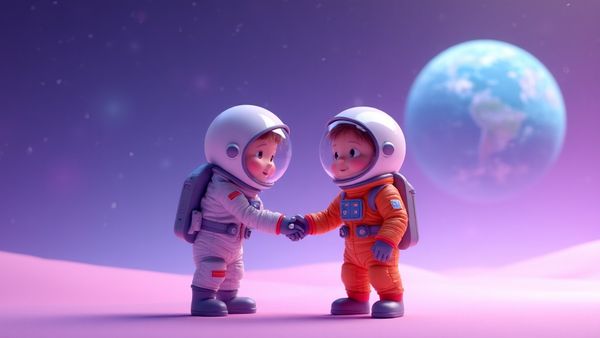
An astronaut is trained by NASA (US) or allied agencies, while a cosmonaut is trained by Russia. Only about 676 people have flown to space by the US definition. Learn the key difference between these brave space explorers!
When you look up at the stars, you might imagine yourself soaring into space! But have you ever stopped to wonder: what do you call the people who actually go there?
You might have heard two different words: astronaut and cosmonaut! Even though both words describe brave explorers who travel beyond our planet, they come from different parts of the world and a famous historical competition called the Space Race. The first person in space was Soviet cosmonaut Yuri Gagarin on April 12, 1961, completing one orbit in just 108 minutes. The very next month, Alan Shepard became the second person in space as America's first astronaut! For kids learning about space, understanding this difference is like knowing the difference between a quarterback and a goalie—both are amazing players, but they play for different teams!

Mira says:
"Wow, Finn! It’s like two different languages for the same super-cool job! 'Astro' means star, and 'Cosmo' means universe. So, an astronaut is a 'star sailor' and a cosmonaut is a 'universe sailor.' I like them both!"
What is the Big Difference Between Astronaut and Cosmonaut?
The main difference between an astronaut and a cosmonaut isn't about how high they fly or what cool experiments they do. It’s all about who trained them!
An astronaut is the term used for people trained and certified by space agencies like NASA (United States), ESA (Europe), CSA (Canada), or JAXA (Japan).
A cosmonaut is the term used *specifically* for someone trained and certified by the Russian Space Agency (Roscosmos) or the former Soviet Union space program.
Think of it like this: if you play soccer for the USA team, you’re on Team USA. If you play for the Russian team, you’re on Team Russia. The sport is the same—traveling in space—but the training teams are different!
Mind-Blowing Fact!
Did you know there’s a third word? People who travel to space on Chinese spacecraft are called taikonauts! It comes from the Chinese word *tàikōng*, which means 'space' or 'cosmos.'
How Many Space Explorers Have There Been?
Since the very first flights, thousands of people dreamed of going to space. But only a few hundred have actually made the journey!
As of late 2023, about 676 people have journeyed to space by the U.S. definition (flying above 50 miles altitude).
The United States has sent the most people, with about 369 representatives who are called astronauts.
Russia/the former Soviet Union follows, having sent 138 cosmonauts.
(The first trip around Earth)
(By late 2023)
(By late 2023)
Who have sent people to space
How Did the Names Get Chosen?
The choice of name really came down to the Space Race between the United States and the Soviet Union in the 1950s and 60s. It was a race to see who could conquer space first!
When the Soviets launched Yuri Gagarin, they wanted a word that was *theirs*. Both terms share the Greek root *naut*, which means 'sailor.'
The Cosmonaut comes from the Greek words *kosmos* (meaning 'universe') and *naut* ('sailor'). So, a universe sailor!
The Astronaut comes from the Greek words *astra* (meaning 'star') and *naut* ('sailor'). So, a star sailor!
The Original Space Pioneers
The first person in space, Yuri Gagarin, flew on Vostok 1 in 1961.
The first American in space, Alan Shepard, flew on Freedom 7 later that same year, but his flight was shorter and didn't go all the way around Earth like Gagarin's!
💡 Did You Know?
Even though the terms are different based on the training agency, today, when astronauts and cosmonauts work together on the International Space Station (ISS), they often use the terms with mutual respect. Sometimes, people say 'astronaut' to mean *anyone* who goes to space, but the specific historical titles stick!
🎯 Quick Quiz!
Which space agency trains a person to be called a COSMONAUT?
Are the Jobs Different?
For the most part, the job is the same: keep yourself and the spaceship safe while conducting science far from Earth! However, because the American and Russian space programs developed separately, their training focused on slightly different skills.
Historically, NASA astronauts had to have lots of flight time and strong engineering knowledge to pilot and service the Space Shuttle.
Cosmonauts historically focused heavily on the systems of their Vostok or Soyuz capsules, as they often had less hands-on control during the early missions compared to US craft.
- Astronauts are trained by NASA, ESA, CSA, or JAXA.
- Cosmonauts are trained by the Russian Space Agency (Roscosmos).
- Taikonauts are trained by the China National Space Administration (CNSA).
- The root *naut* in both words means 'sailor'—a star sailor or a universe sailor!
No matter what you call them—astronaut, cosmonaut, or taikonaut—these brave men and women are truly history makers! They are pushing the boundaries of what humans can do, all in the name of science and adventure for kids like you to learn about!
Questions Kids Ask About Space
Keep Exploring the Cosmos!
Now you know the secret handshake of space travel terms! Next time you watch a launch, you can tell your friends exactly whether you are watching an astronaut or a cosmonaut blast off. Keep looking up and dreaming big!