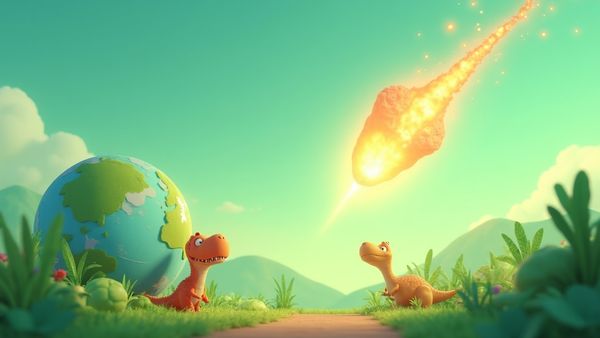
The asteroid that killed the dinosaurs was a massive space rock, about 10 to 15 km wide, that struck Earth 66 million years ago. This impact created the Chicxulub Crater and ended the Cretaceous Period. Learn how this giant collision changed our planet forever!
Imagine you're walking through a lush, ancient forest, and then—BAM!—a rock from space, bigger than any mountain, smashes into Earth! That’s not a movie plot; it’s what really happened to the amazing dinosaurs.
About 66 million years ago, the world was ruled by dinosaurs, from speedy Raptors to the mighty T-Rex. But then came a terrifying, world-changing event: a giant space rock, an asteroid, slammed into our planet! This huge collision is the main reason the non-avian dinosaurs disappeared, marking the end of the Cretaceous Period and the start of a new era. We're talking about a rock that was about 10 to 15 kilometers (6 to 9 miles) wide!

Mira says:
"It's crazy to think that something from way out in space caused such a massive change right here on Earth! It makes you realize how connected our planet is to the rest of the solar system."
What is the Asteroid That Killed the Dinosaurs?
The space traveler that caused all this trouble is often just called the 'dino-killer asteroid.' Scientists have a very specific name for the massive hole it left behind: the Chicxulub Crater!
This giant space rock was likely made of dark, carbon-rich material, making it a carbonaceous chondrite asteroid. It was hurtling through space at a speed of about 20 kilometers per second (or over 58 times the speed of sound!) when it hit.
Mind-Blowing Fact!
The word 'Chicxulub' comes from the Mayan language and means 'tail of the devil!' What a fitting name for the impact site!
How Big Was the Impact's Energy?
Trying to imagine the power of this crash is tough, but we can use things we know today! This single impact released an amount of energy equal to 100 trillion tons of TNT!
To put that into perspective for kids: that's like setting off 4.5 billion of the most powerful atomic bombs all at once! The resulting crater was gigantic, about 180 to 200 kilometers (110 to 120 miles) wide and nearly 20 to 30 kilometers (12 to 19 miles) deep before it filled in!
When the impact occurred
(6-9 miles) wide
(110-120 miles) wide
Approximate percentage of species that went extinct
How Did One Asteroid End an Entire Era?
It wasn't just the *smash* that did it. That moment was the start of a terrible chain reaction that changed the whole planet for years!
The Immediate Blast and Fire
Right when it hit the shallow ocean off the Yucatán Peninsula (in modern-day Mexico), the asteroid instantly vaporized rock and water. Super-hot winds blew out for hundreds of miles, likely starting global firestorms!
The Giant Waves
The impact immediately created a massive tsunami—a sea wave so huge it’s called a megatsunami! The wave might have been up to 4.5 kilometers (2.8 miles) high near the impact zone, washing over parts of the continents.
The Long Winter
This is the big one! The crash blasted tons of dust, ash, and vaporized rock high into the atmosphere. This cloud circled the globe, blocking out the sun for months or even years!
When the sun couldn't reach the Earth, plants and tiny ocean life (plankton) couldn't make food through photosynthesis. This caused a global impact winter that stopped the food chain from the bottom up, which is what caused the mass extinction.
💡 Did You Know?
We know this happened because scientists found a thin layer of special clay all over the world that dates back exactly 66 million years. This layer has way more of an element called iridium than normal Earth rock, and iridium is much more common in asteroids!
🎯 Quick Quiz!
Where did the giant asteroid that killed the dinosaurs hit the Earth?
Why Did Some Animals Survive?
If the impact was so bad, how did *anything* survive? Not every dinosaur died—the ones that became modern birds made it through! Animals that were small, could burrow, or didn't need to eat plants right away had a better shot.
- Small Dinosaurs that could hide underground or eat insects/seeds were safer than giants.
- Mammals survived because many were small and could live in burrows, escaping the worst of the heat and darkness.
- Aquatic Animals like sea turtles and crocodilians survived, perhaps because the oceans didn't suffer the immediate *total* food collapse that land plants did.
- The birds we see today are the direct descendants of the dinosaurs that survived this event!
The extinction event wasn't just about the dinosaurs; about 75% of all plant and animal species on Earth vanished! It was a massive cleanup that cleared the way for new types of life, including our own distant mammal ancestors, to take over and eventually lead to humans!
Questions Kids Ask About Prehistory
The Power of Space Rocks!
Even though this event was a total disaster 66 million years ago, it’s one of the most important moments in Earth’s history! It shows us that our planet is always changing, and sometimes, the biggest changes come from way out in space. Keep listening to History's Not Boring to find out what happened next!