
The Apollo 11 mission was the historic first journey that landed humans on the Moon in July 1969. Astronauts traveled about 238,855 miles to reach the lunar surface! Learn about the crew, the spacecraft, and the famous first steps on another world.
What if I told you that not too long ago, humans actually left planet Earth and bounced around on the dusty surface of the Moon?
It sounds like science fiction, but it really happened! The Apollo 11 mission was the incredible journey that made it possible. It was the first time in all of history that people walked on another world! The mission was part of a huge challenge set by President John F. Kennedy to land an American astronaut on the Moon and bring them back safely before the 1960s ended. The journey began on July 16, 1969, and the whole trip lasted 8 days, 3 hours, 18 minutes, and 35 seconds! It was a massive victory for teamwork and amazing science!

Mira says:
"Wow, Finn! Imagine floating through space for three whole days just to get to the Moon! I bet looking back at our beautiful blue Earth from that far away felt like looking at the best marble ever! That's a super long trip for a first visit!"
What Were the Three Amazing Parts of the Apollo 11 Spacecraft?
The Apollo 11 spacecraft wasn't just one thing; it was like a team of connected vehicles working together! There were three main parts that helped the astronauts on their journey.
First, there was the Command Module (CM), nicknamed *Columbia*. This was the astronauts' home base! It was the only part that came all the way back to Earth and splashed down in the Pacific Ocean. Think of it as the crew cabin and control center.
Second was the Service Module (SM), which was attached to *Columbia*. This part carried the big engine, plus all the power, oxygen, and water the crew needed for most of the trip. It was the support system!
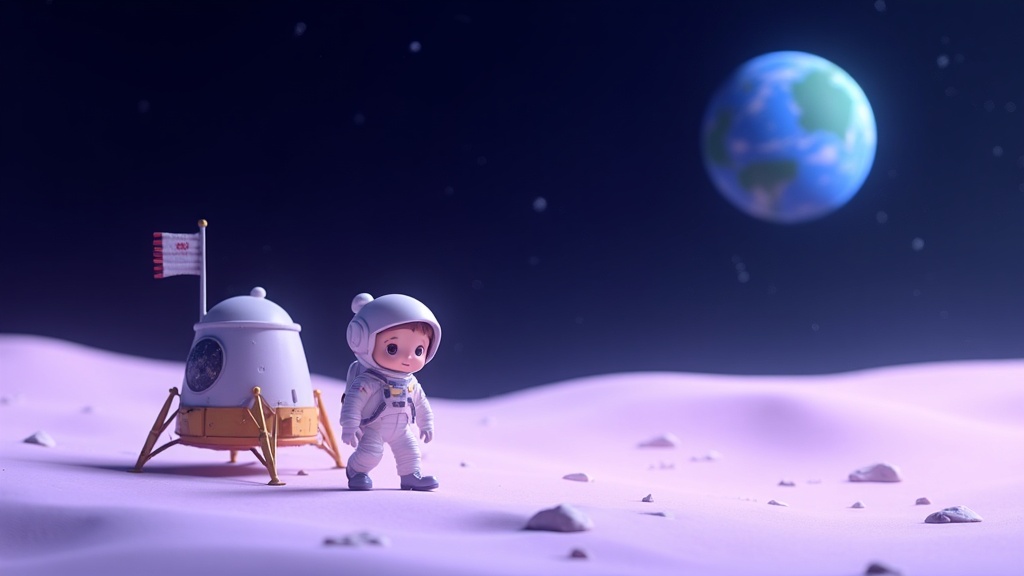
Finally, there was the Lunar Module (LM), nicknamed *Eagle*. This was the special vehicle designed *only* for landing on the Moon and taking off again. Only two astronauts squeezed inside *Eagle* to hop down to the surface, while the third astronaut stayed behind in *Columbia* orbiting above.
Mind-Blowing Fact!
The giant rocket that launched Apollo 11 was called the Saturn V! It was so tall it was as tall as 50 elephants stacked on top of each other! It had to be super powerful to push the whole spacecraft away from Earth's gravity.
Apollo 11: By the Numbers!
History-making moments are often filled with amazing statistics. These numbers show just how far humanity reached on this mission for kids to learn about!
The average distance from Earth to the Moon is about 238,855 miles! That's a huge distance to travel in space.
When Neil Armstrong took his first step, an estimated 650 million people watched the live television broadcast back on Earth. That's almost as many people as live in all of Europe and the Americas combined!
(47.5 pounds)
(EVA Time)
(UTC Time)
How Did They Land Safely on the Moon?
Landing the *Eagle* was the trickiest part of the whole mission. Even though the landing was planned to be smooth, things got exciting right at the end!
The computer guided *Eagle* towards a spot that turned out to be full of giant rocks and craters—not a safe place for a landing! Because of this, Commander Neil Armstrong had to take control of the Lunar Module manually.
He flew the *Eagle* over the dangerous area, searching for a clear spot, all while Mission Control in Houston was counting down the fuel. When he finally set *Eagle* down safely in an area called the Sea of Tranquility, they had only about 17 to 45 seconds of fuel left!
Mind-Blowing Fact!
After landing, when Neil Armstrong stepped out, he said the most famous words ever spoken in space: “That’s one small step for [a] man, one giant leap for mankind.”
Who Were the Three Brave Astronauts?
Apollo 11 was a three-person team, and every single person had a super important job!
Neil Armstrong: The Commander and the very first human to step onto the Moon. He was an amazing pilot and engineer.
Buzz Aldrin: The Lunar Module Pilot. He was the second person to walk on the Moon, joining Armstrong just 19 minutes after the first step.
Michael Collins: The Command Module Pilot. He bravely stayed up in orbit around the Moon inside *Columbia* while Armstrong and Aldrin were on the surface. He was the crucial link between the Moon explorers and Earth!
💡 Did You Know?
Even though they explored for about 2.5 hours on the Moon, Armstrong and Aldrin were only on the surface for a total of 21 hours and 36 minutes before blasting off to rejoin Michael Collins!
🎯 Quick Quiz!
What was the nickname of the Lunar Module that landed on the Moon?
Why Was Apollo 11 So Important for Science?
The mission wasn't just a race to the Moon; it was a major science trip! When the astronauts were down on the dusty surface, they weren't just waving a flag.
They collected about 21.5 kilograms (or 47.5 pounds) of moon rocks and soil to bring back to Earth for scientists to study.
They also set up cool experiments, like a seismometer to measure 'moonquakes' and a laser retroreflector. This reflector allows scientists *today* to bounce lasers off the Moon to measure the exact distance between the Earth and the Moon!
- They left behind a special plaque saying: “Here men from the planet Earth first set foot upon the Moon, July 1969.”
- They deployed experiments to study moonquakes and solar wind.
- They bounced around easily because the Moon's gravity is much weaker than Earth's—about one-sixth as strong!
After the moonwalk, the *Eagle* blasted off and rejoined *Columbia*. The crew then coasted back to Earth, splashing down safely in the Pacific Ocean on July 24, 1969! Because no one knew if they brought back any hidden space germs, the heroes of Apollo 11 had to spend 21 days in quarantine before they could hug their families!
Questions Kids Ask About Space
Keep Exploring!
The Apollo 11 mission showed the world what humans can achieve when we work together with amazing technology and bravery. Every time you look up at the night sky, remember that people have walked on that bright, dusty ball! Keep learning, keep dreaming big, and maybe someday YOU will be the expert on the next giant leap for humankind!