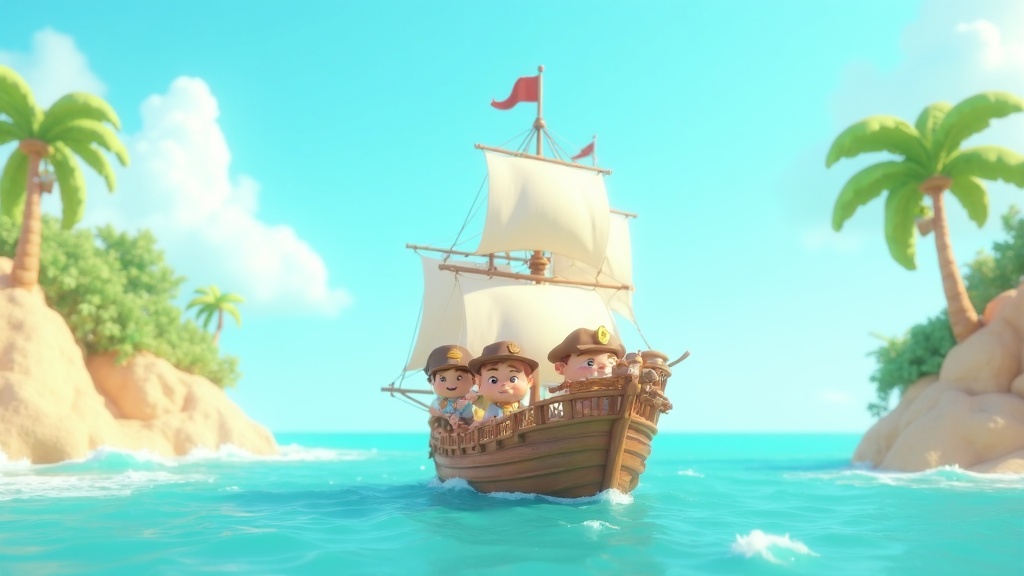
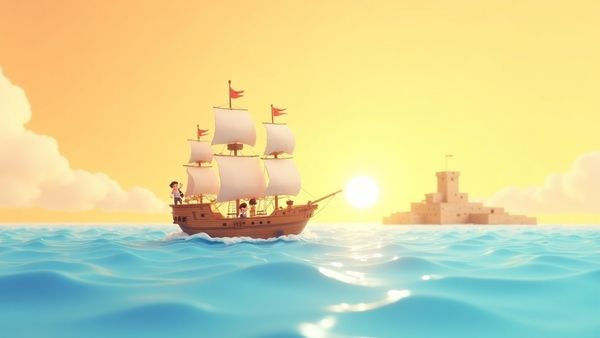
The 1492 Columbus voyage was Christopher Columbus's first major expedition from Spain to the Americas, aiming to find a new route to Asia by sailing west. It took 71 days to reach land after leaving the Canary Islands! This journey launched the Age of Exploration and changed world maps forever.
What if you set sail on a tiny ship, in a tiny wooden boat, with no idea where you'd end up? That’s exactly what Christopher Columbus did in the year 1492!
This was a HUGE time in history called the Age of Exploration! Explorers like Columbus were trying to find faster, safer ways to get from Europe to Asia for valuable things like spices and silk. Columbus, an Italian navigator sailing for Spain, had a super bold idea: what if you sailed straight west across the giant Atlantic Ocean to reach the East Indies? Most people thought this was a crazy, impossible trip, but Columbus was convinced! He finally convinced the Spanish monarchs, Queen Isabella and King Ferdinand, to pay for his adventure. He left Spain on August 3, 1492, ready to change the map of the world forever for kids and grown-ups alike!

Mira says:
"Imagine being stuck on the ocean for weeks with only your crew and the stars to guide you! That's the kind of bravery explorers needed, even when they didn't know what was waiting across the waves."
What Was Columbus’s Famous Fleet Like?
Columbus didn't sail a giant modern cruise ship! His fleet for this famous first trip included three small vessels.
The biggest ship was the Santa María, which was the flagship—that means it was the main ship where Columbus stayed. It was a *carrack*, which was a bit slower and wider.
The other two ships were much smaller and faster ships called *caravels*. They were the Niña (which means 'The Girl') and the Pinta (which means 'The Painted One'). These were often used by sailors for quick travel!
Mind-Blowing Fact!
Did you know the Niña was Columbus's favorite ship? He even bought half a share in it before his second voyage and used it as his flagship then!
How Many Miles Did They Sail and How Long Did It Take?
Sailing in the 1400s was tough! There were no engines, only sails catching the wind. The sailors had to deal with storms, sickness, and the scary thought of sailing off the edge of the world (even though educated people knew the Earth was round!).
Columbus left from Palos de la Frontera, Spain. After a quick stop in the Canary Islands, the real adventure began! It took them about 71 days from the moment they left the Canary Islands to finally spot land.
The excitement was so high that when sailors thought they saw land on October 10th, Columbus had to calm everyone down so they wouldn't stop searching too soon. Finally, early on October 12, 1492, land was sighted!
How Did Columbus Decide Where to Go First?
When land was spotted, Columbus and his crew landed on an island in the Bahamas. Columbus decided to rename it San Salvador Island.
The area was already home to Native American peoples, like the Lucayan, Taíno, and Arawak. Columbus mistakenly believed he had reached islands near Asia, which is why he called the people there 'Indians'—a name that stuck for a long time because of his mistake!
The Fate of the Santa María
Sadly, the flagship didn't make it home! On Christmas Day, December 25, 1492, the Santa María ran aground on a sandbar near Hispaniola (an island that is now Haiti and the Dominican Republic).
The ship was badly damaged and had to be abandoned. The crew used the wood to build a small fort, which Columbus named La Navidad (Spanish for 'Christmas'). He left 39 men behind there before heading back to Spain with the Niña and Pinta.
💡 Did You Know?
The year 1492 was also super important for Spain itself! In that same year, the Christian kingdoms in Spain finally defeated the last Muslim rulers in the city of Granada, finishing a long effort called the Reconquista and unifying Spain under Christian rule!
🎯 Quick Quiz!
What did Christopher Columbus mistakenly call the Native Americans he first met?
Why Was This Voyage So Important for History?
Columbus’s 1492 voyage officially kicked off the Age of Exploration and connected two separate worlds: the 'Old World' (Europe, Africa, Asia) and the 'New World' (the Americas).
This led to the Columbian Exchange, a huge transfer of plants, animals, culture, technology, and even diseases between these two parts of the world.
It also started the long and often difficult process of European colonization in the Americas, which changed life for everyone living there forever.
- The Goal: Find a western sea route to the spice-rich East Indies.
- The Ships: Niña (caravel), Pinta (caravel), and Santa María (carrack/flagship).
- The Discovery: Landed in the Bahamas (San Salvador Island) on October 12, 1492.
- The Legacy: Started the connection between Europe and the Americas, leading to massive change.
Even though Columbus didn't 'discover' a land that was already home to millions of people, his journey in 1492 was a turning point that created global connections—for better and for worse—that still shape our world today!
Questions Kids Ask About Explorers
Keep Charting Your Own Course!
The 1492 voyage was an incredible journey filled with risk, hope, and huge consequences. Thinking about explorers like Columbus helps us see how brave people were when the world felt so much bigger! Keep being curious, keep learning about history's big moments, and always be ready for your own adventure!