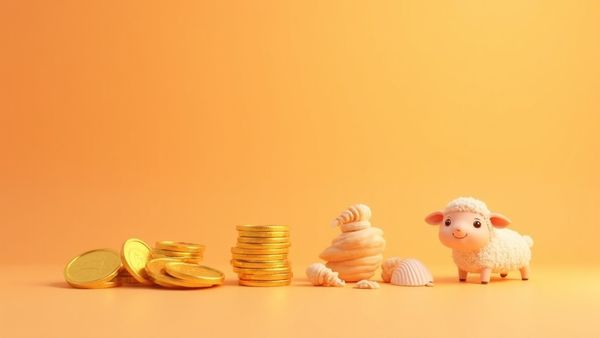
Nobody invented money — it evolved over 9,000 years. People first used cattle as currency around 9000 BC. Cowrie shells became widespread money by 1200 BC. The first metal coins were stamped in Lydia (modern Turkey) around 600 BC, made from electrum, a gold-silver alloy. Paper money was invented in China during the Tang Dynasty (7th century AD). Each step solved the same problem: making trade easier and fairer.
Nobody woke up one morning and said, "I just invented money!" The truth is stranger — and way more interesting.
Money wasn't invented. It evolved, slowly, over thousands of years, on every continent, as people tried to solve the same annoying problem: how do you trade fairly when you've got a cow and you only need a haircut? The answer took humanity from bartering livestock around 9000 BC, to trading cowrie shells and salt, to stamping the first metal coins in 600 BC, to printing paper money in China, all the way to tapping a phone at a checkout. Every step made trade a little bit easier — and changed the world along the way. Want to learn more about how money works today? Visit our Money for Kids section for guides on saving, earning, and investing.

Mira says:
"Think about it — for most of human history, if you wanted new shoes, you had to find a shoemaker who wanted exactly what you had to trade. No wonder people spent thousands of years trying to figure out a better system!"
When Was Money Invented?
There's no single date because money didn't appear all at once. It showed up in stages, spread across thousands of years and dozens of civilizations. Here's the short version of the timeline:
Around 9000 BC, people in Mesopotamia and other early farming communities started using cattle — cows, sheep, and goats — as a standard way to measure value. A healthy cow was worth roughly the same everywhere, so it became a kind of living currency.
By about 1200 BC, cowrie shells had become one of the most popular forms of money in China, India, and Africa. They were small, durable, impossible to fake, and beautiful — perfect money.
The first metal coins appeared in the kingdom of Lydia (modern Turkey) around 600 BC. And paper money was invented in China during the Tang Dynasty, around the 7th century AD.
Each step solved a real problem. Cattle were valuable but hard to divide (you can't give someone half a cow). Shells were portable but couldn't be standardized. Coins fixed both problems — and paper money solved the weight problem of carrying thousands of coins.

Before Coins: The Wild World of Commodity Money
Before anyone thought of coins, people traded using barter — swapping goods directly. A farmer might trade a sack of grain for a new axe. But barter had a huge flaw called the "double coincidence of wants": both people had to want what the other one had, at the same time. If the axe-maker didn't need grain that day, no deal.
To fix this, communities started agreeing that certain items were always valuable. These are called commodity money — things that had real, practical use and could be traded anywhere:
Cattle (from about 9000 BC) were one of the oldest forms. The word "capital" actually comes from the Latin word capita, meaning "head" — as in head of cattle. The word "pecuniary" (meaning related to money) comes from pecus, Latin for cattle.
Salt was so valuable that Roman soldiers received part of their pay in salt — that's where the word "salary" comes from (the Latin salarium).
Cowrie shells were used as currency for over 3,000 years, from China to West Africa to the Pacific Islands. They were nature's almost-perfect money: uniform in size, extremely durable, lightweight, and impossible to counterfeit.
Other commodity money included grain, tea bricks (compressed blocks of tea leaves used in Central Asia), cacao beans (used by the Aztecs), polished shell beads called wampum (used by Native American peoples in North America), and even giant stone discs on the Pacific island of Yap, some weighing over 4 tonnes.

Mind-Blowing Fact!
On the island of Yap in the Pacific, people used enormous circular stones called rai as money. Some were 3.6 metres (12 feet) across! They were so heavy that nobody actually moved them — everyone just agreed who owned which stone. It's a bit like how your bank balance works today: the number changes, but nobody physically moves anything.
Who Invented Coins?
The invention of the coin was one of humanity's biggest breakthroughs — and it happened in Lydia, an ancient kingdom in what is now western Turkey.
Around 650–600 BC, the Lydians started stamping small lumps of metal with an official mark — usually a lion's head. This stamp was a government guarantee of two critical things: the metal's purity (it was really gold and silver, not fake) and its weight (so you didn't need to carry a scale everywhere).
The first coins were made from electrum, a naturally occurring alloy of gold and silver found in the riverbeds of Lydia. They were bean-shaped and rough by modern standards, but they were revolutionary.
The most famous Lydian ruler, King Croesus (who ruled from about 560 to 546 BC), took things further by minting coins of pure gold and pure silver — separate denominations with fixed values. He became so wealthy that the expression "rich as Croesus" is still used today, 2,500 years later.
But Lydia wasn't the only place experimenting with metal money. Around the same time, China was developing its own system using small bronze pieces shaped like miniature farming tools — tiny knives and spades — as currency. And cities in India were punching marks into silver bars. The idea of standardized metal money seems to have emerged independently in several places at once.

💡 Did You Know?
Some of the earliest Chinese 'coins' weren't round at all — they were shaped like miniature bronze knives and spades, imitating the real farming tools that had been used as commodity money before them. Round coins with a square hole in the centre (called ban liang) appeared later, around 350 BC, and became the standard shape of Chinese coins for the next 2,000 years.
How Coins Spread Across the Ancient World
Once coins proved useful in Lydia, the idea spread fast. The ancient Greeks adopted coins within decades and added their own twist — decorating them with images of gods, mythological creatures, and city symbols. The owl coin of Athens became one of the most trusted currencies in the Mediterranean.
The Romans took coins even further. They stamped portraits of their emperors onto every coin, spreading their rulers' faces across an empire of 60 million people. Roman coins have been found as far away as India, China, and sub-Saharan Africa — proof of how far ancient trade networks reached.
Coins weren't just money. They were tiny, portable billboards — spreading propaganda, recording history, and building trust across vast distances.
🎯 Quick Quiz!
Where were the first officially stamped metal coins invented?
Who Invented Paper Money?
Coins were a massive improvement over cattle and shells — but they had their own problem. They're heavy. If you needed to buy something expensive, like a shipment of silk, you'd need a cart full of copper coins just to pay for it.
The Chinese solved this problem with one of history's most practical inventions: paper money.
It started during the Tang Dynasty (618–907 AD) when merchants began leaving their heavy coins with trusted deposit shops and carrying paper receipts instead. These receipts could be exchanged back for coins at any participating shop — an early version of a bank cheque.
By the Song Dynasty (960–1279 AD), the Chinese government started printing official paper notes called jiaozi — the world's first government-issued paper currency. They were printed on special mulberry bark paper with multiple ink colours and official seals to prevent counterfeiting.
Paper money didn't reach Europe until much later. Sweden became the first European country to issue paper banknotes in 1661, through the Stockholm Banco. And the United States first printed paper money (called "Continentals") during the Revolutionary War in 1775 to pay soldiers — though those early notes quickly lost their value because too many were printed.
The famous explorer Marco Polo was astonished when he visited China in the 13th century and saw paper money in widespread use. He wrote about it in wonder — Europeans wouldn't adopt the idea for another 400 years.

🎯 Quick Quiz!
Who invented paper money?
From Paper to Plastic to Phones: Money Today
The story doesn't stop at paper. Money has kept evolving, getting lighter and faster with every generation:
Credit cards appeared in the 1950s — the first general-purpose card was the Diners Club card, introduced in 1950 by businessman Frank McNamara after he forgot his wallet at a restaurant.
Electronic banking took off in the 1970s and 1980s, allowing money to move between accounts as digital signals — no physical cash involved.
Cryptocurrency, starting with Bitcoin in 2009, introduced the idea of digital money that isn't controlled by any government or bank.
Today, in countries like Sweden and China, most purchases are made without touching physical money at all. But the core idea is exactly the same as those first Lydian coins: money works because everyone agrees it has value.
Whether it's a cowrie shell, a gold coin stamped with a lion, a paper note, or a number on a screen — money is just a shared agreement that makes trading possible.

- Portable: Easy to carry (a coin beats a cow every time).
- Durable: It lasts — metal doesn't rot like grain, and paper doesn't break like a shell.
- Divisible: You can make change. You can split a dollar into cents, but you can't split a cow into useful pieces.
- Accepted: Everyone agrees it has value, backed by a government or shared trust.
No single person invented money. It was a slow, brilliant evolution driven by millions of people across thousands of years, all trying to solve the same basic problem: how do we trade fairly? From cows to cowrie shells, from electrum coins to paper notes, from credit cards to cryptocurrency — the story of money is really the story of human ingenuity. Want to dive deeper? Explore our Money for Kids section to learn about how money works today, including the full history of money timeline and what money actually is.
Questions Kids Ask About Economics
Keep Exploring the Story of Money!
Next time you buy something — whether with a coin, a card, or a tap on a phone — remember you're part of a 9,000-year-old story. Every piece of currency in the world traces back to those first farmers who decided a cow was worth a certain number of bushels of grain. Explore more about how money works in our dedicated Money for Kids section!