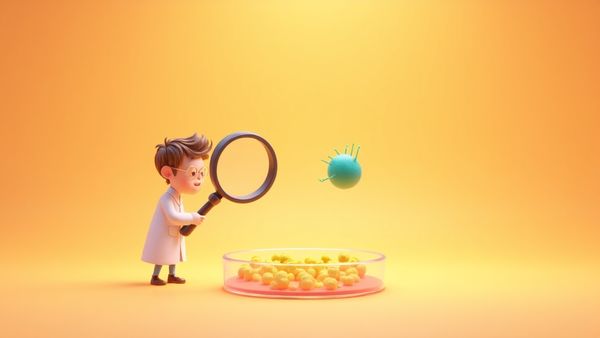
Penicillin is the world's first antibiotic, a medicine that acts like tiny soldiers fighting off dangerous bacteria inside our bodies. Discovered accidentally in 1928, it changed medicine forever by helping us fight infections like strep throat.
Imagine a time when a simple scratch from a rose thorn could be super dangerous, or when a cough could turn into a deadly sickness! Yikes! Before one amazing discovery, fighting bad bacteria was incredibly hard.
But then came a HUGE moment in science history! We are talking about penicillin, the very first antibiotic, which is like a secret weapon against tiny, germy invaders! The hero of this story is a scientist named Sir Alexander Fleming, who made his famous discovery in 1928 in London, England. He found that a fuzzy, greenish mold was actually killing the bad bacteria he was studying! It’s one of the greatest victories ever achieved over disease!

Mira says:
"Wow, Mira! So, you’re telling me a scientist was messy, went on vacation, and came back to find mold that made medicine? That sounds like a real-life treasure hunt! It proves that being curious, even when things look 'ruined,' is the key to science!"
What is Penicillin Anyway?
Penicillin is a type of medicine called an antibiotic. Think of antibiotics as tiny, specialized soldiers whose only job is to fight off bad bacteria.
Bacteria are living things, and some types can make us super sick with infections like strep throat or pneumonia.
Penicillin works by stopping the bacteria from building the strong walls they need to grow and make more of themselves. No new walls, no more bad guys!
Mind-Blowing Fact!
Fun Fact: The first name Alexander Fleming gave to the substance made by the mold was actually 'mould juice'! Not very catchy, right? He later settled on 'penicillin' after the mold itself, Penicillium notatum.
The Numbers Behind the Discovery
Fleming’s discovery on September 3, 1928, kicked off a journey that took years! It wasn't an instant miracle drug you could buy tomorrow.
For a long time, Fleming could only produce tiny, tiny amounts. He found the mold could stop bacteria even when it was diluted 800 times!
It wasn't until 1939 that other scientists, like Howard Florey and Ernst Chain, figured out how to make enough of it to actually use as medicine.
When Fleming noticed the mold
Shared by Fleming, Florey, and Chain
By the end of WWII
How Did Fleming Accidentally Find Penicillin?
This is the best part! It was all about being a good observer—even when things look like a huge mistake. Dr. Fleming was working at St. Mary's Hospital in London.
He went on holiday, leaving some of his plates full of Staphylococcus bacteria sitting out on his lab bench. When he got back, he found one dish was messy and had been contaminated with a blue-green mold.
The 'Oops' Moment
Instead of just throwing the moldy dish away, Fleming looked closely. He noticed that right around the fuzzy mold, the Staphylococcus bacteria could not grow!
He realized this mold was making something that killed the bad bacteria, which was exactly what he wanted!
Fleming realized this special 'mold juice' could possibly fight off the deadly infections that were so common back then.
💡 Did You Know?
Did You Know? Before penicillin was ready for everyone, Dr. Fleming had seen soldiers die from infected wounds in World War I. That experience made him determined to find a way to control terrible infections!
🎯 Quick Quiz!
What type of organism produced the first penicillin?
Who Took Penicillin to the Finish Line?
Fleming found it, but he couldn't make enough to save millions. That's where other brilliant scientists stepped in almost ten years later!
Scientists like Howard Florey and Ernst Chain took Fleming's research and figured out how to grow, purify, and turn the 'mold juice' into a real, usable medicine.
- The Oxford Team: Florey, Chain, and another scientist named Norman Heatley worked hard to mass-produce the drug.
- World War II: The need for a medicine to treat wounded soldiers made them speed up the process!
- The First Human Trial: In 1941, a policeman named Albert Alexander was the first civilian to get penicillin, but they ran out, and sadly, he passed away.
- Mass Production: By 1942, they found ways to make huge amounts, saving countless lives during the war and after!
Because of this amazing teamwork—Fleming’s initial observation, and Florey and Chain’s development—all three shared the Nobel Prize in Medicine in 1945! It shows that even the messiest mistakes can lead to something that helps everyone!
Questions Kids Ask About Science History
Keep Exploring Like Dr. Fleming!
Next time you see moldy bread (yuck!), remember the incredible story of penicillin! It teaches us two big things for kids: Always be curious, and sometimes, the biggest breakthroughs happen when you least expect them. Stay curious, history explorers!