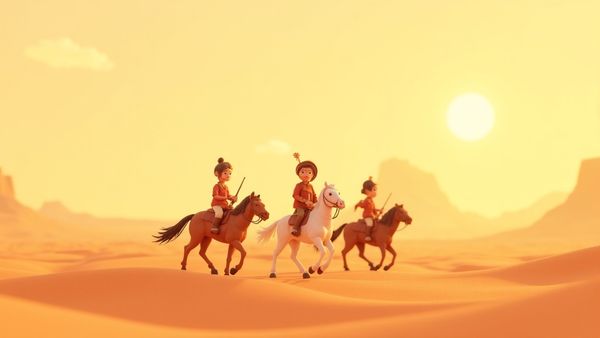
The Mongol Empire was the largest contiguous land empire the world has ever seen, officially founded in 1206 by Genghis Khan. This massive realm stretched from the Pacific Ocean to Eastern Europe! Kids will learn how horse-riding nomads achieved this incredible feat of speed and conquest.
What if one person could unite almost everyone on a huge part of the planet? Get ready for a story of incredible speed, unbelievable distance, and massive change!
We're traveling back in time to meet the incredible Mongols! This group of nomadic horse-riders from the central Asian steppes created the largest contiguous land empire the world has ever seen. The empire began in 1206 when their amazing leader, Genghis Khan, brought all the scattered tribes together. In just a few decades, their reach stretched from the Pacific Ocean all the way to Eastern Europe! That’s like riding a horse from New York all the way to California, and then way past it!
Finn says:
"Wow, an empire that big? I bet they had the best horses! I wonder if their roads were as fast as our highways?"
What Was Life Like Before the Empire?
Before the empire, the people we call Mongols lived in small, separate tribes way out on the grassy plains known as the Steppe. Think of it like having lots of little neighborhoods where everyone was kind of competing with the others.
They were amazing at living off the land, constantly moving their tents (called gers) and herding animals like cattle, sheep, and yaks. Their best friend was the horse—they were expert riders and archers from the moment they could walk!
These tribes often fought each other. But then, one super-smart, super-tough leader came along: Temüjin.
The Rise of Genghis Khan!
Temüjin had a tough start to life, but he was a genius at making friends and enemies into allies. After many battles and clever plans, he managed to unite all the separate Mongol and Turkic tribes under one rule.
In 1206, at a big meeting called a kurultai, the leaders all agreed: Temüjin would be their supreme ruler, taking the title Genghis Khan, which means 'Universal Ruler'! This was the official birthday of the Mongol Empire.
Genghis Khan wasn't just about fighting; he was also a great organizer. He changed the way the army worked, making sure people moved up based on how well they did their jobs, not just who their family was.
Mind-Blowing Fact!
Genghis Khan was born sometime between 1155 and 1167, but Mongolia officially celebrates his birthday in 1162! Legend says he was born holding a small piece of blood in his hand, which was thought to be a sign of greatness!
How Did They Conquer So Much Land So Fast?
The Mongol army was like nothing anyone had ever seen before! Imagine a thousand super-fast race cars that can also shoot arrows perfectly from far away—that was the Mongol cavalry.
They didn't just charge in wildly. They were masters of surprise attacks, fake retreats to trick their enemies into chasing them into traps, and they communicated using special signal flags and drums on the battlefield.
If a city refused to surrender, the Mongols could be very scary. But if a city surrendered right away, they were often treated much better! They also copied the best ideas from the people they conquered, like new siege weapons from China.
(23 million sq. km)
(The main years of the empire)
(The empire broke into four parts)
The Amazing Mongol Peace: Pax Mongolica
Wait, how can an empire built on conquest also be good for trade? After the fighting stopped, the Mongols created something called the Pax Mongolica, or the Mongol Peace.
This was a long period where the roads and trade routes across Asia, like the famous Silk Road, became much safer than before. Think of it as the world's first giant, safe delivery service for ideas, inventions, and goods!
Because the empire controlled so much land, people could travel farther than ever before without worrying about lots of different armies stopping them. This helped spread things like paper, gunpowder, and even new cooking ideas across continents!
What Traveled on the Pax Mongolica Roads?
It wasn't just silks and spices! The exchange of knowledge was huge:
Ideas: New ways of thinking about medicine and astronomy traveled from the Middle East to China.
Technology: Inventions like printing and paper money traveled west.
Food: New crops and cooking techniques spread in both directions.
💡 Did You Know?
When Genghis Khan died in 1227, he was buried in a secret location! The Mongols made sure no one could ever find his grave, keeping his resting place a huge historical mystery.
🎯 Quick Quiz!
What was the name given to the period of peace and safe trade under the Mongol Empire?
Why Did the Giant Empire Shrink?
Even the biggest things don't last forever, especially when they are that big! After Genghis Khan died, his sons and grandsons took over, but they started to disagree on who should be the ultimate ruler.
The massive empire was eventually divided into four main parts, or Khanates: the Yuan Dynasty in China, the Golden Horde in the north, the Chagatai Khanate in Central Asia, and the Ilkhanate in Persia.
Over time, these separate parts began to act more like their own countries and slowly faded away, with the last part officially ending in the 14th century.
- They were fast: Mongol soldiers could ride for days without stopping, often changing horses.
- They were organized: They used a written law code called the Yassa.
- They were adaptable: They quickly learned new technologies from the people they fought.
- They spread culture: They connected East and West like never before!
So, the Mongol Empire might have been built with massive armies, but its greatest legacy for world history was actually connecting people. They didn't just conquer land; they connected the world's trade maps for a while, which is a pretty amazing thing for kids learning history to remember!
Questions Kids Ask About World History
Keep Exploring the Steppes!
From the great horsemen of the Steppe to the largest empire in history, the story of the Mongols is a wild ride! Think about how one person's vision could change the map of the world so quickly. Keep listening, keep reading, and never stop being curious!