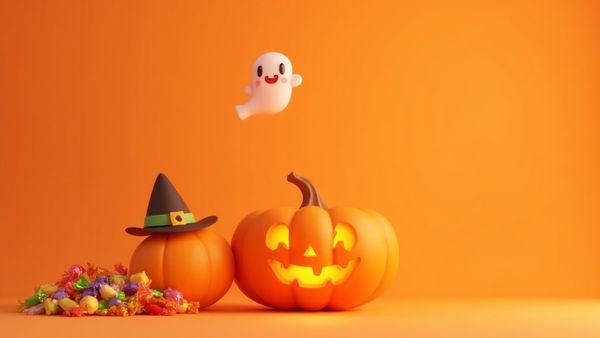
Halloween originated over 2,000 years ago with the ancient Celtic festival called Samhain (pronounced "SAH-win"). This tradition marked the end of summer when Celts believed the boundary between the living and the dead blurred. This led to early traditions like bonfires and wearing disguises to ward off spirits.
Get ready for costumes, candy, and creepy-crawlies! Have you ever stopped to wonder where Halloween actually comes from?
It’s one of the most fun nights of the year for kids, but the history of Halloween is much older and spookier than you might think! It’s a mashup of ancient traditions, all mixed together over thousands of years. The holiday we celebrate on October 31st has roots stretching back over 2,000 years to a Celtic festival called Samhain (pronounced “SAH-win”). For the Celts, this festival marked the end of summer and the start of the cold, dark winter.

Mira says:
"Wow, Mira! So you’re telling me that before candy corn, people were lighting huge bonfires and wearing costumes to trick ancient spirits? That sounds like a very brave history lesson!"
What Was Samhain, the First Halloween?
The Celts lived in areas that are now Ireland, Scotland, and parts of France and the UK. They believed that on the night of Samhain, the line, or boundary, between the world of the living and the world of the dead became very thin.
This meant ghosts and spirits could walk on Earth for just one night! To keep the spooky things happy or to scare away any mean spirits, the Celts did two big things: they lit huge bonfires and they wore disguises made of animal skins.
These fires helped keep the darkness away, and the costumes helped the Celts blend in with the spirits so the ghosts would leave them alone! They even left food outside on their doorsteps as offerings to keep the spirits satisfied.
Mind-Blowing Fact!
The traditional Halloween colors, orange and black, actually come from Samhain! Orange stood for the autumn harvest, and black stood for the darkness of winter.
When Christianity Met Celtic Customs
As time went on, Christianity spread across Europe. In the eighth century, a Pope named Gregory III decided to make November 1st a day to honor all the Christian saints—this became All Saints' Day.
This new Christian holiday got mixed up with the old Samhain traditions that people already loved. Since November 1st was now All Saints' Day, the night before, October 31st, became known as All Hallows' Eve, which eventually got shortened to Halloween!
Later, All Souls' Day was added on November 2nd to remember all the dead. This time period became known as Allhallowtide, and it kept that special focus on honoring the dead.
Samhain tradition began
Blending with Samhain
Halloween starts growing in America
How Did Jack-o'-Lanterns Get So Bright?
Today, we carve big, spooky faces into pumpkins, but that wasn't the original plan! The tradition of carving a scary face comes from an old Irish legend about a tricky man named Stingy Jack.
Jack was so naughty that when he died, he couldn't go to Heaven, and the Devil wouldn't let him into the Underworld. The Devil supposedly gave Jack only a burning coal to light his way as he wandered the dark night forever!
The Irish carved scary faces into turnips and stuck the glowing coals inside to scare away wandering spirits like Jack. When Irish immigrants came to America in the 1800s, they discovered something much bigger and easier to carve: the pumpkin!
From Souling and Guising to Trick-or-Treating
The modern "Trick-or-Treat!" has two main ancestors. First, there was 'Souling' in England and Ireland during the Middle Ages. Poor people, often children, would go door-to-door promising to pray for the homeowner's dead relatives in exchange for a small pastry called a soul cake.
Second, in Scotland and Ireland, there was 'Guising'. Kids in costumes would perform a trick—like singing a song or telling a joke—to earn a treat, which was usually fruit or nuts, not candy.
These traditions traveled with immigrants to America. In the early 1900s, people started using 'trick-or-treat' as a way to ask for treats in exchange for not playing a naughty trick! The candy boom really made the phrase popular in the US by the 1930s and 1940s.
💡 Did You Know?
Some historians think the game of bobbing for apples—a fun Halloween party game today—started as a way for young people to find out who they might marry someday, based on a Roman festival honoring Pomona, the goddess of fruit!
🎯 Quick Quiz!
What was the original vegetable the Irish used to carve scary faces into before coming to America?
Why Do We Dress Up Anyway?
The reason we wear costumes is one of the oldest parts of the celebration! Back during Samhain, people wore costumes to confuse or hide from the spirits roaming the Earth.
In the Christian era, people sometimes dressed as saints, angels, or devils during related celebrations, like All Souls' Day. Today, we wear costumes to be spooky, funny, or to dress up as our favorite superheroes—it’s all about having fun and joining the festivities for kids!
- Ancient Celts: Celebrated Samhain, marking the New Year and the start of winter.
- Christian Influence: Pope Gregory III moved All Saints’ Day to November 1st, creating 'All Hallows' Eve.'
- Jack-o'-Lanterns: Started with scary faces carved into turnips in Ireland.
- Souling/Guising: The tradition of going door-to-door for food in exchange for prayers or entertainment.
- Modern Fun: Immigrants brought traditions to the U.S., where it became the candy-focused holiday we love today!
Halloween shows us how history is always moving and changing! What started as an ancient festival to welcome the dark half of the year has turned into a safe, exciting, and candy-filled night where everyone gets to be someone (or something!) else for a few fun hours.
Questions Kids Ask About Holidays
Keep Exploring the Past!
Now you know that your spooky costume isn't just for fun—it’s part of a history that is thousands of years in the making! Keep asking questions, and don't forget to check out our other episodes to discover more amazing history stories!