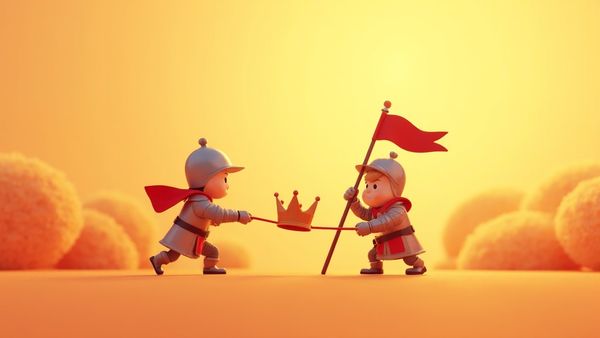
The Battle of Hastings was the decisive fight in 1066 where William the Conqueror defeated King Harold Godwinson to claim the English throne. Fighting lasted from 9:00 AM until dusk! This battle dramatically changed England's language and rulers forever.
What happens when two super-strong leaders both think they should be King of England?
It’s the year 1066, and England is about to have one of its biggest, most famous fights ever: the Battle of Hastings! This wasn't just any small skirmish; it was a battle that changed the whole country's story, its language, and even how people lived! The main characters in this epic tale are King Harold Godwinson, the newly crowned English King, and William, the powerful Duke from Normandy in France, who believed he should have the throne. Their argument ended on a chilly day in October near a town that is now called Battle!

Mira says:
"Wow, fighting for a crown is serious business! It's amazing how one day’s battle, like Hastings, can change a whole country’s future for hundreds of years!"
What Was the Big Deal About the English Throne?
Imagine the King of England, Edward the Confessor, dying in January 1066, and—uh-oh—he didn't have a clear son to take over! This meant a few very important people thought they had the best claim to the crown. Harold Godwinson, the most powerful noble in England, was crowned quickly. But William, the Duke of Normandy, said, 'Wait a minute! Edward promised me the crown!' It was a massive mess, like a playground argument but with real armies!
Mind-Blowing Fact!
Did you know that William the Conqueror was actually William the Bastard first? That’s because his parents weren't married when he was born, but he certainly proved everyone wrong by becoming King!
The Two Mighty Armies Facing Off
The armies were built very differently, which made the fight exciting! King Harold’s English forces were mostly tough foot soldiers, famous for their shield wall. Think of it like a giant, living brick wall made of wood and men, all standing shoulder-to-shoulder with big battle axes! William’s Norman army was a mixed group, bringing powerful archers (bow and arrow experts) and, super importantly, cavalry—soldiers who fought on horseback!
1066
Unusually long for the time!
Led by Harold
In London, 1066
How Did William's Army Win the Day?
The battle itself, which took place on Senlac Hill, was long and very hard-fought. Harold’s shield wall was super strong at the top of the hill. William’s soldiers tried attacking it many times but just bounced off! So, William decided to try a super clever (and sneaky!) trick that worked perfectly for kids to learn about.
The 'Feigned Flight' Trick
The Norman soldiers, especially the cavalry, pretended to run away in panic! They galloped backward down the hill, making the English think they were winning. The English soldiers, perhaps too excited, broke their mighty shield wall to chase after them. This was exactly what William wanted! Once the English formation was broken, the Normans turned around and charged the now scattered, individual English fighters.
💡 Did You Know?
The whole battle is famously captured in an incredible, long piece of embroidery called the Bayeux Tapestry! It’s like a massive, ancient comic book showing the whole story, from William setting sail to King Harold's dramatic end.
🎯 Quick Quiz!
What famous Norman trick caused the English shield wall to break?
Why Does This Battle Still Matter for Kids Today?
The Battle of Hastings ended the rule of the Anglo-Saxons, who had been in charge for over 600 years! When William won, he became King William I, or William the Conqueror. Because the new rulers all spoke French, many French words flooded into the English language. So, when you say words like 'beef' (from French 'bœuf') or 'liberty,' you’re hearing echoes of the Battle of Hastings!
- King Harold II was the last crowned Anglo-Saxon king of England.
- The battle took place about 7 miles (11 km) northwest of the actual town of Hastings.
- It is often said that King Harold died from an arrow to the eye, but historians aren't 100% sure—he was definitely killed, though!
- William ordered a beautiful church, Battle Abbey, to be built on the spot where Harold fell.
The victory at Hastings led to the Norman Conquest, which brought huge changes to England, like building powerful stone castles and changing the laws. It truly was the moment when medieval England got a major, history-shaping makeover!
Questions Kids Ask About British History
Keep Exploring History's Biggest Moments!
The Battle of Hastings shows us how one big moment can change everything—from the food we eat to the words we use! Keep digging into history, because as you can see, it’s never boring when kings are fighting over crowns!