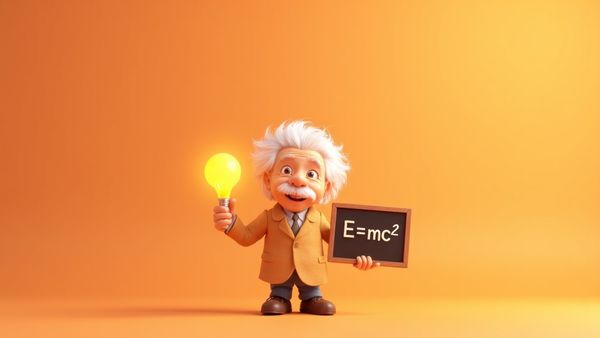
Albert Einstein was born in 1879 in Germany and became the most famous scientist of the 20th century. His Theory of Relativity changed how we understand space, time, and gravity. His equation E=mc² revealed that a tiny bit of mass holds a huge amount of energy. He won the 1921 Nobel Prize for explaining the photoelectric effect.
What if we told you that one person's imagination could completely rewrite the rules of the entire universe? That's exactly what Albert Einstein did!
Albert Einstein was born on March 14, 1879, in Ulm, Germany, and grew up to become the most famous scientist of the 20th century. Even though he looked a little goofy with his legendary wild hair, his ideas were super serious — they changed everything we thought we knew about space, time, energy, and even gravity itself. In this guide, you'll discover Einstein's surprising childhood, learn how his Theory of Relativity works, decode the world's most famous equation (E=mc²), and find out why his discoveries still power the technology we use every single day!

Finn says:
"Whoa! So, you're telling me that a tiny little pebble has a HUGE amount of energy hiding inside it, just waiting to pop out? That's way cooler than a toy exploding!"
Einstein's Early Life
When Albert Einstein was a little kid, his parents actually worried about him — he was very slow to learn to talk! Some people even thought he wouldn't speak until he was four years old. But young Albert's brain was working in its own special way.
At age five, something magical happened: his father showed him a simple compass. The way the needle always pointed north, moved by an invisible force, completely fascinated little Albert. That moment sparked a lifelong love of science mysteries!
Einstein didn't love the strict, memory-focused style of his German schools — he found the rules boring and preferred to teach himself the things that truly interested him. After finishing school in Switzerland, he got a job as a patent clerk, checking other people's inventions. But guess what? This steady, quiet job gave his mind the perfect time to wander into the mysteries of space and time!

Mind-Blowing Fact!
Einstein often gave his beloved violin a sweet nickname: Lina! He loved playing music almost as much as he loved thinking about science, and believed that music and science were deeply connected.
The 'Miracle Year' That Changed Everything
Imagine changing the world with just four papers! In 1905, when Einstein was only 26 years old and still working at the patent office, he published four amazing scientific papers that totally rocked the world of physics. This incredible year is often called his annus mirabilis, or 'miracle year.'
One paper explained how tiny particles of light (called photons) could knock electrons off metal surfaces — this is called the photoelectric effect, and it's what won him the Nobel Prize in Physics in 1921. Another paper introduced the world to the Special Theory of Relativity and the famous equation E=mc². All four papers came from a 26-year-old clerk with no fancy laboratory — just an incredible imagination!
Born March 14 in Ulm, Germany
Published four game-changing papers
For explaining the photoelectric effect
Died in Princeton, New Jersey

Theory of Relativity Explained
The Theory of Relativity is Einstein's biggest and most mind-bending idea. It actually comes in two parts: Special Relativity and General Relativity. Together, they changed how we understand space, time, and gravity forever!
The word 'relative' means that measurements of space and time can actually change depending on who is looking and how fast they are moving. Imagine you're on a super-fast train and you toss a ball straight up. To you, it goes straight up and comes straight down. But to your friend standing still outside, that ball is moving forward with the train AND up and down. You both see different motions, but both of you are right! Einstein said there is no absolute best viewpoint — it's all relative.
Special Relativity: The Speed of Light Rule
Einstein's Special Theory of Relativity (from 1905) has one truly mind-blowing rule: the speed of light is always the same for everyone, no matter how fast they are moving! Light travels at about 186,000 miles per second — that's fast enough to zoom around the entire Earth about seven and a half times in just one second!
This is the universe's ultimate speed limit. Nothing with mass can ever reach the speed of light. And here's the really weird part: the faster you move through space, the slower you move through time! This is called time dilation. Astronauts moving very fast actually age a tiny, tiny bit slower than people on Earth.
General Relativity: Gravity Bends Space!
The second part, the General Theory of Relativity (finished around 1915), is all about gravity. Before Einstein, Isaac Newton thought gravity was an invisible force pulling objects together. Einstein said, 'Nope! Gravity is actually curves in spacetime!'
Think of spacetime like a giant, invisible trampoline that fills the whole universe. Imagine putting a heavy bowling ball (like the Sun) on this trampoline. It makes a big dip! Now, roll a smaller marble (like Earth) nearby — it doesn't get 'pulled' by a force, it just rolls into the dip the bowling ball made. That rolling into the curve is what we feel as gravity!

💡 Did You Know?
Your phone's GPS system needs Einstein's Theory of Relativity to work correctly! The satellites orbiting Earth experience time slightly differently than we do on the ground, so scientists use Einstein's math to keep your location accurate.
Breaking Down E=mc²: The Universe's Secret Recipe
The Special Theory of Relativity led to the most famous equation in the world: E=mc²! This short but mighty formula explains a huge secret about the universe.
In this equation, E stands for Energy, m stands for Mass (the 'stuff' in things), and c is the speed of light — about 299,792,458 meters per second! The little '²' means you multiply that already gigantic number by itself. Because 'c²' is such an enormous number, this equation tells us that a tiny bit of mass can be turned into a HUGE amount of energy.
How huge? If you could convert just a single paperclip's mass entirely into energy, it would release the power of about 18 kilotons — that's an incredible amount of energy hiding in something so small! This discovery was essential for understanding how stars shine and how nuclear energy works.
The Speed of Light (c)
Energy in a single paperclip's mass
Time for light to reach Earth
🎯 Quick Quiz!
What did Albert Einstein win the Nobel Prize in Physics for in 1921?
Why Einstein Changed Science
Einstein wasn't just a scientist — he was a thinker about big world problems too. He was born Jewish and lived in Germany, but when the Nazi Party took power in 1933, it became dangerous for him to stay. He was visiting the United States at the time and wisely decided not to return home.
He took a special job at the Institute for Advanced Study in Princeton, New Jersey, where he continued to work on physics for the rest of his life. Einstein also used his fame to speak out for peace and civil rights. He even turned down the chance to become the second President of Israel!
Einstein's Lasting Legacy
Even though Einstein passed away on April 18, 1955, in Princeton, his ideas are still powering our world today. GPS navigation, nuclear energy, lasers, and even the way scientists study black holes — all of these depend on Einstein's theories.
He also wrote a famous letter to President Roosevelt warning that Germany might be building an atomic bomb, which helped start the U.S. research program. After the war, he deeply regretted the bomb's destructive use and became one of the most outspoken supporters of world peace.
- He was a German-born physicist who later became a Swiss and then an American citizen.
- He loved music! Einstein played the violin beautifully and believed music and science were connected.
- He worked as a patent clerk before making his world-changing discoveries — proof that genius can bloom anywhere!
- He was a humanitarian who spoke out for peace, civil rights, and against nuclear weapons.
- He disliked strict schooling and preferred to teach himself the things that truly interested him.
Albert Einstein showed us that the most important tool a scientist — or a kid! — can have is a curious mind. From a quiet boy fascinated by a compass to the genius who unlocked the secrets of space and time, Einstein's story proves that asking 'Why?' and 'What if?' can truly change the world.
Questions Kids Ask About Famous People
Keep Questioning Everything!
Albert Einstein showed us that it's okay to be different, to question everything, and that even someone who struggled with parts of school can go on to unlock the deepest secrets of the universe. Never stop asking 'Why?' or 'What if?' — you might just come up with the next big idea that changes the world!